
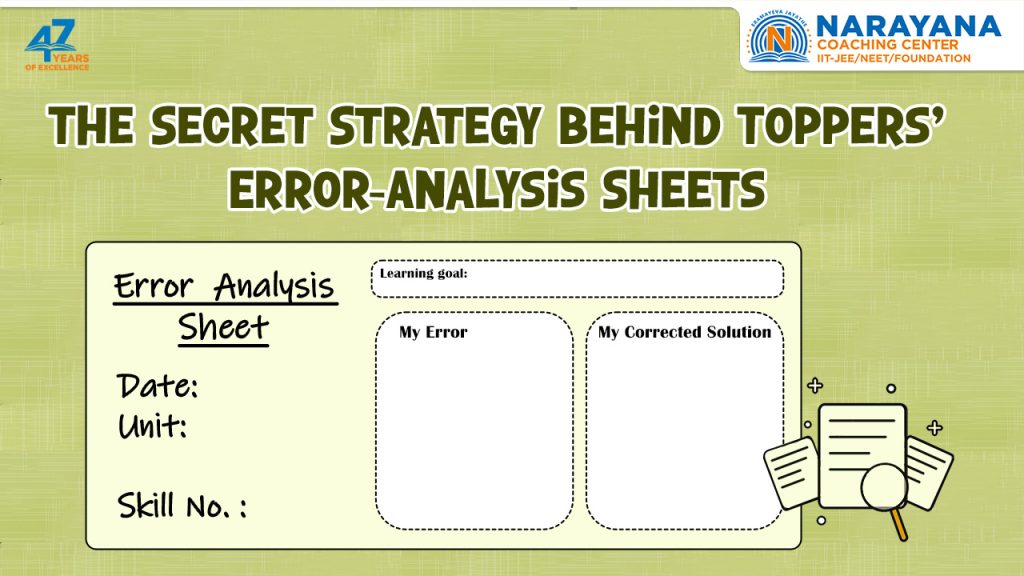
Preparing for JEE or NEET is no less than a marathon—long, intense, and mentally demanding. Every topper has a secret weapon that sets them apart, and it’s not just intelligence or hard work—it’s the Error Analysis Sheet.
This simple yet powerful strategy helps toppers analyse, reflect on, and improve their performance systematically. Let’s uncover how toppers use it, why it works so well, and how you can implement it to maximise your marks.
What Exactly Is an Error Analysis Sheet?
An Error Analysis Sheet is a structured log where students record mistakes from mock tests, practice papers, or daily problem-solving sessions.
It’s not merely a list of wrong answers but a detailed breakdown of why the mistake happened and how to prevent it in the future.
A typical sheet includes:
| Column | Details |
| Question/Topic | The chapter or test from which the question was taken |
| Type of Error | Conceptual, Calculation, Silly Mistake, or Misinterpretation |
| Cause of Error | Why it happened (lack of concept clarity, time pressure, etc.) |
| Correct Concept | The correct approach or method |
| Strategy for Improvement | How to avoid repeating the error |
This sheet acts as a mirror, reflecting your performance beyond marks. It shows your thought process and highlights areas that need attention.
Why Toppers Swear by Error Analysis Sheets
Toppers don’t just practise; they practise strategically. The error analysis sheet is their compass, guiding them toward precision and mastery.
Here’s why it works wonders:
- Identifies Patterns of Mistakes:
You start noticing repetitive errors—like forgetting formulae in physics or sign mistakes in chemistry. Awareness is the first step towards correction. - Transforms Weaknesses into Strengths:
By focusing on recurring topics or tricky question types, you turn your weakest chapters into scoring ones. - Reduces Silly Mistakes:
Many students lose 10–20 marks due to avoidable mistakes. Recording them keeps your mind alert during the next test. - Increases Conceptual Clarity:
Revisiting mistakes forces you to understand concepts more deeply instead of just memorisation. - Boosts Confidence Before Exams:
A quick revision of your error sheet before tests or final exams reminds you of past pitfalls and how to dodge them.
How to Create Your Own Error Analysis Sheet (Toppers’ Format)
You don’t need fancy tools—a notebook, spreadsheet, or digital planner will do.
Follow these five simple steps to create your own topper-style error sheet:
Step 1: Record Every Test Attempt
After every mock test or daily quiz, record all questions you got wrong or guessed.
Don’t skip small errors; even a “silly” one counts.
Step 2: Categorise the Error
Label the type of mistake:
- Conceptual misunderstanding
- Formula error
- Calculation error
- Misreading the question
- Time mismanagement
Step 3: Analyse the Root Cause
Ask yourself:
- Did I rush through the question?
- Did I misunderstand the concept?
- Was I low on time or confidence?
Understanding why the error occurred helps you eliminate the cause.
Step 4: Write the Correct Method
Rework the question and note the proper approach. You can even paste a small snippet from your textbook or coaching notes here.
Step 5: Review Regularly
Revisit your error analysis sheet every Sunday or after every 2–3 tests.
The goal is to spot improvement trends—fewer repetitive errors = real progress.
A Glimpse Into a Topper’s Error Sheet
| Question Topic | Error Type | Root Cause | Correct Concept | How to Avoid |
| Electrostatics (JEE Main 2023 Mock) | Conceptual | Confused potential with potential energy | Review the derivation of the potential energy formula | Revise notes and attempt 5 similar problems |
| Organic Chemistry (Hydrocarbons) | Silly Mistake | Skipped the negative sign in the calculation | Recheck signs before the final answer | Slow down during revision |
| Human Physiology (NEET) | Time Management | Spent too long on one question | Practise sectional timing | Set a timer for each section |
When used consistently, this method becomes your personalised improvement tracker—more powerful than any test-series result.
How Often Should You Use It?
Toppers typically update their error analysis sheets:
- After every full-length mock test
- After every subject-wise practice test
- Once a week for revision
This habit keeps learning continuous and performance-oriented.
In just 4–6 weeks, you’ll notice fewer recurring mistakes and sharper accuracy.
Common Mistakes Students Make with Error Sheets
Even the best tool fails if it is used incorrectly. Avoid these common pitfalls:
- Not Being Honest:
Writing only “tough” mistakes and ignoring silly ones defeats the purpose. Record everything. - Not Reviewing Regularly:
If you don’t revisit your sheet, you’ll repeat the same errors in the next test. - Overcomplicating the Format:
Keep it simple—clarity matters more than design. - Ignoring Time-Based Errors:
Time mismanagement is one of the biggest reasons for lost marks. Include it as an error type.
Why This Strategy Works for Both JEE and NEET
While JEE demands problem-solving and analytical thinking, NEET focuses on speed, accuracy, and retention.
Error analysis supports both by helping you:
- Strengthen conceptual depth (for JEE)
- Enhance accuracy and recall (for NEET)
- Track performance trends in physics, chemistry, and biology/maths
- Develop exam temperament under pressure
It’s a universal success method, adaptable to both exams.
Bonus Tip: Digital vs. Physical Error Sheets
Both formats have pros and cons. Here’s a quick comparison:
| Type | Pros | Cons |
| Physical Notebook | Easy to revise, provides tangible focus | Can become bulky over time |
| Google Sheets / Excel | Easily searchable; shareable with mentors | Requires regular updates |
| App-Based Trackers | Auto-saves performance data | Limited customisation |
Choose whichever format you’re most comfortable with—the goal is consistency, not the medium.
Conclusion: The Secret That Turns Hard Work Into Smart Work
The Error Analysis Sheet isn’t just a notebook—it’s your secret performance lab. It transforms hard work into measurable improvement.
Every topper uses it not because it’s fancy, but because it’s effective.
So, the next time you finish a test, don’t rush to the next one. Pause. Analyse. Learn.
That’s how toppers turn every mistake into a stepping stone to success.
FAQs About Toppers’ Error Analysis Sheets
- How many errors should I record per test?
Record all of them—even if there are 50. Every mistake is an opportunity to improve. - Should I include guessed answers that turned out right?
Yes! If it was a lucky guess, it’s still a potential weak area. - How long does it take to fill an error sheet?
Usually, 20–30 minutes per test, but this time pays off massively in your next performance. - Can I use the same sheet for all subjects?
You may maintain one combined sheet or separate ones for physics, chemistry, and biology/maths—whichever helps you stay organised. - Do toppers really use this method?
Absolutely! Many AIR 1 to 100 rankers have credited this practice with refining their accuracy and boosting their ranks. - How do I make revisions efficiently using this sheet?
Before every test, revise only the mistakes from the last 2–3 sheets. This quick recall prevents repetition and improves accuracy.