
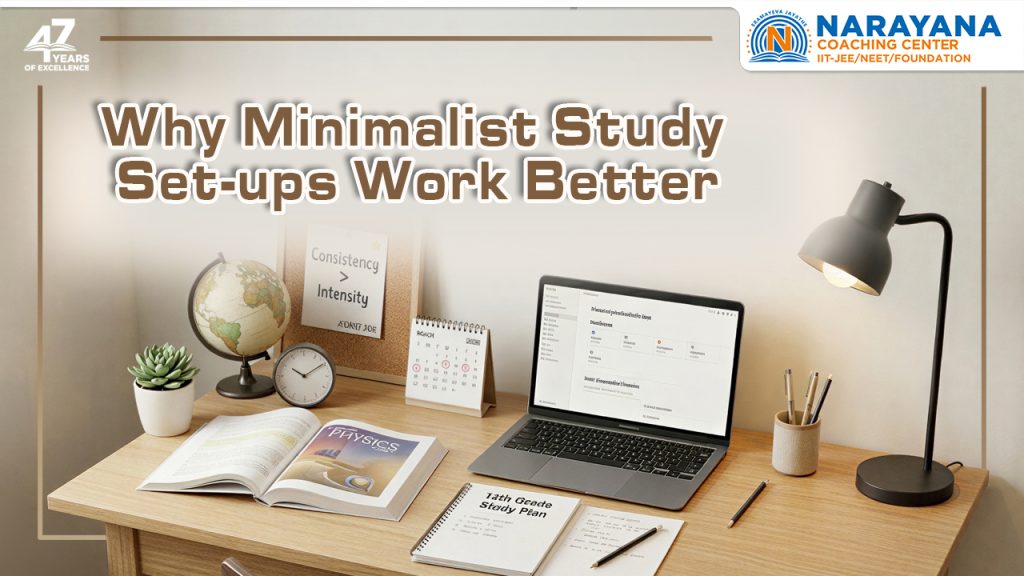
If you are preparing for JEE or NEET, your study space matters more than you think.
Many aspirants spend hours planning timetables, solving mock tests, and analysing PYQs — but ignore one powerful factor: the environment in which they study.
A cluttered desk leads to a cluttered mind.
A focused space builds a focused brain.
In this blog, let us understand why a minimalist study setup can significantly improve concentration, productivity, and retention — especially for high-pressure exams like JEE Main, JEE Advanced, and NEET.
What Is a Minimalist Study Setup?
A minimalist study setup is:
- A clean desk
- Limited objects in view
- Only essential books and tools
- Neutral colours
- Zero digital distractions
It is not about aesthetic Instagram setups. It is about cognitive efficiency.
Your goal is not to impress.
Your goal is to rank.
The Science Behind Minimalism and Focus
Your brain has limited working memory capacity.
When your table is full of:
- Extra books
- Random notes
- Phone notifications
- Gadgets
- Food wrappers
- Sticky reminders everywhere
Your brain keeps processing visual signals subconsciously.
This creates cognitive overload.
For JEE and NEET aspirants, this is dangerous because:
- Physics requires deep concentration.
- Organic Chemistry requires uninterrupted flow.
- Biology requires memory consolidation.
Minimalism reduces:
- Visual noise
- Decision fatigue
- Attention switching
And increases:
- Sustained focus
- Retention
- Speed of problem solving
Why It Matters More for JEE and NEET Students
Competitive exams are not about studying “more.”
They are about studying deeply and consistently for 1–2 years.
Let us understand how minimalist setups specifically help aspirants.
1. Improves Long Study Hours
JEE and NEET preparation demands 6–10 focused hours daily.
A cluttered environment:
- Triggers micro-distractions
- Encourages frequent breaks
- Increases mental fatigue
A clean desk:
- Signals “work mode” to the brain
- Reduces excuses to get up
- Improves sitting stamina
When your desk only has:
- One book
- One notebook
- One pen
- A water bottle
Your mind has no escape route.
2. Reduces Digital Distraction
For aspirants, the biggest enemy is not the syllabus — it is the smartphone.
A minimalist study rule:
- Phone outside the room
- Laptop only for tests/lectures
- No unnecessary tabs open
Even seeing your phone on the desk reduces focus by up to 20–30%.
If you are serious about cracking JEE or NEET, your setup should scream:
“This is a preparation zone, not a scrolling zone.”
3. Enhances Concept Retention
When you study in a clean environment:
- Your attention is deeper.
- Your neural encoding is stronger.
- Your recall becomes faster.
For NEET aspirants memorising NCERT Biology, or JEE aspirants solving multi-step Physics problems, retention quality determines rank.
Minimalist spaces improve memory consolidation because there are fewer competing stimuli.
What an Ideal Minimalist Study Setup Looks Like
A powerful study desk includes:
Essential Items Only:
- Current subject textbook
- Rough notebook
- 2–3 pens
- Highlighter (optional)
- Water bottle
- Table lamp
Remove:
- Extra guidebooks
- Decorative clutter
- Snacks
- Tablet unless needed
- Random sticky notes everywhere
Remember:
Your desk should contain only what your current chapter needs.
Minimalism Reduces Decision Fatigue
Every time you see:
- Multiple books
- Different modules
- Too many colour pens
- Several unfinished notebooks
Your brain makes small decisions.
These micro-decisions consume mental energy.
JEE and NEET require thousands of high-quality decisions:
- Which formula to apply?
- Which option to eliminate?
- Whether to skip a question?
If you waste decision power on “Which pen should I use?”, you reduce performance quality.
Minimalist setups preserve mental energy for what matters.
Psychological Advantage During Exam Season
During the final 3–4 months before JEE or NEET:
- Anxiety increases
- Mock scores fluctuate
- Self-doubt creeps in
A neat, organised desk provides psychological stability.
It creates:
- Visual calmness
- Control over environment
- A sense of discipline
And discipline builds confidence.
How to Transition to a Minimalist Study Setup
You don’t need to renovate your room.
Follow this 5-step reset:
Step 1: Desk Detox
Remove everything from your study table.
Step 2: Add Back Essentials
Place only:
- Today’s subject book
- Rough notebook
- Pen
- Water bottle
Step 3: Create a Storage Box
Keep other materials inside a drawer or box — out of sight.
Step 4: Fix Lighting
Use soft white lighting. Avoid harsh yellow bulbs.
Step 5: Phone Rule
Keep it outside the study zone.
Small changes create massive productivity shifts.
Common Myths About Study Setups
Myth 1: More Books on Desk = More Motivation
Reality: More books = More overwhelm.
Myth 2: Aesthetic Setup Improves Performance
Reality: Clean setup improves performance. Aesthetics are optional.
Myth 3: Music and TV in Background Helps
Reality: For competitive exams, deep focus beats background stimulation.
Minimalism Is Not Just Physical — It’s Mental
You can also apply minimalism to:
- Study resources (limit to selected books)
- Coaching materials (avoid hoarding PDFs)
- Strategy (stick to one clear plan)
Top rankers often succeed because they simplify.
They do not chase every new resource.
They master limited ones deeply.
Final Thought: Rankers Think Differently
A topper’s mindset is not flashy.
It is:
- Disciplined
- Structured
- Minimal
- Focused
Your study table should reflect your ambition.
If your goal is JEE Advanced under AIR 1000 or NEET 650+, your environment must support that intensity.
Minimalism is not about less.
It is about removing what does not serve your goal.
Clean desk.
Clear mind.
Better rank.