
If you’re in Class 11 or 12, chances are you’ve already faced this dilemma:
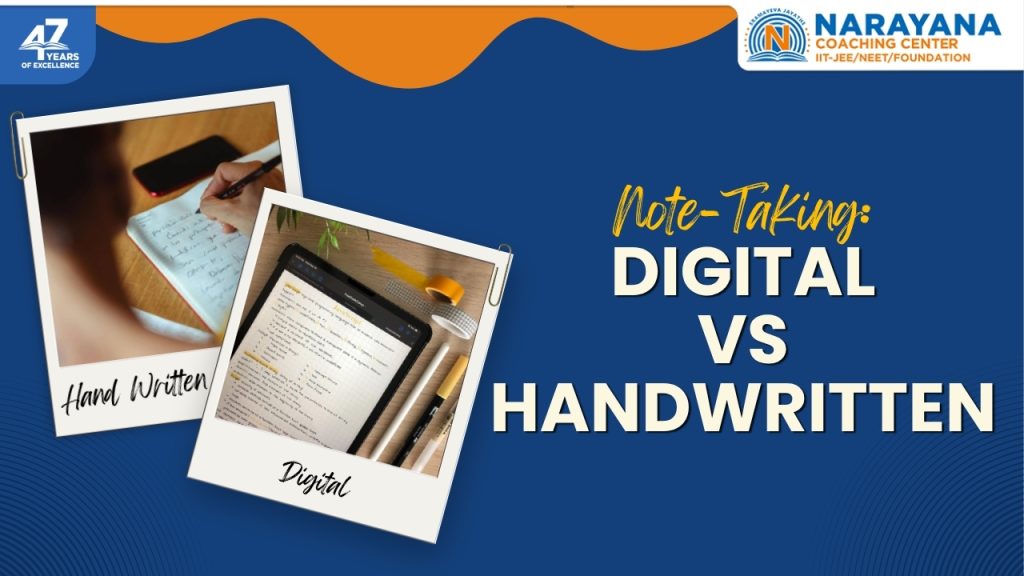
Should I make notes on my laptop/tablet or stick to pen and paper?
With board exams, competitive exams like JEE and NEET, and heavy syllabi, your note-making strategy can directly impact how well you revise, recall, and perform.
Let’s break this down in a simple, practical way—so you can decide what works best for you.
Why Notes Matter More Than You Think
Before choosing the format, understand this:
Notes are not just for writing—they are for thinking.
Good notes help you:
- Simplify complex concepts (especially Physics and Chemistry)
- Organise information logically
- Revise quickly before exams
- Retain information longer
The real question isn’t just how you write—but how well your notes help you learn.
Handwritten Notes: The Classic Approach
Let’s start with the traditional method.
✅ Advantages of Handwritten Notes
- Better Memory Retention
Writing by hand slows you down—in a good way.
You process information, summarise it, and then write it. This improves understanding and recall. - Ideal for Problem-Solving Subjects
Subjects like Maths and Physics require step-by-step working.
Handwriting allows you to:
- Draw diagrams
- Solve numericals
- Practice derivations easily
- Fewer Distractions
No notifications. No tabs. No scrolling.
Just you, your notebook, and your focus. - Stronger Conceptual Clarity
Because you cannot copy-paste, you are forced to understand before writing.
❌ Disadvantages of Handwritten Notes
- Time-Consuming
Writing everything manually can be slow, especially during fast-paced classes or coaching sessions. - Hard to Edit or Update
Made a mistake? Need to add a point?
You either rewrite or manage with messy corrections. - Storage Issues
Multiple subjects = multiple notebooks = clutter.
Digital Notes: The Modern Method
Now let’s look at the digital side.
✅ Advantages of Digital Notes
- Speed and Efficiency
Typing is faster than writing.
You can capture more information in less time—especially during lectures. - Easy Organisation
Apps like Notion, OneNote, or Google Docs allow you to:
- Create folders by subject
- Use search features
- Tag important topics
- Edit Anytime
You can:
- Add points later
- Rearrange content
- Highlight or format easily
- Access Anywhere
Your notes are available across devices—laptop, tablet, or phone. - Integration with Resources
You can insert:
- Diagrams
- Videos
- PDFs
- Screenshots from lectures
❌ Disadvantages of Digital Notes
- Lower Retention (for some students)
Typing often becomes passive.
You may copy content without fully understanding it. - Distractions Are Real
One notification → WhatsApp → Instagram → 30 minutes gone. - Not Ideal for All Subjects
Typing equations, diagrams, or organic chemistry structures can be inconvenient. - Screen Fatigue
Long hours on devices can strain your eyes and reduce focus.
What Do Toppers Actually Do?
Here’s the truth:
Most high-performing students don’t choose one—they combine both.
They use:
- Handwritten notes for core understanding and practice
- Digital notes for organisation and quick revision
The Best Strategy for Class 11 & 12 Students
Instead of asking which is better, ask:
👉 Where should I use each method?
📘 Use Handwritten Notes For:
- Maths problem-solving
- Physics derivations and numericals
- Chemistry mechanisms and reactions
- Diagrams and flowcharts
- Rough work and practice
💻 Use Digital Notes For:
- Class summaries
- Revision notes (short and crisp)
- Formula sheets
- Mistake logs
- Doubt tracking
- Saving PDFs and extra resources
A Smart Hybrid System (Highly Recommended)
Here’s a practical system you can start using immediately:
Step 1: Learn → Write by Hand
During class or self-study:
- Write concepts in your notebook
- Solve problems manually
Step 2: Summarise → Digitally
After studying:
- Create short digital notes
- Add bullet points, formulas, and key takeaways
Step 3: Revise → Both
- Use digital notes for quick revision
- Use handwritten notebooks for deep practice
Common Mistakes Students Make
Avoid these pitfalls:
❌ Writing everything without understanding
❌ Copy-pasting digital notes from others
❌ Making notes too lengthy
❌ Not revising notes regularly
❌ Switching methods too often
Remember:
Consistency matters more than the format.
Final Verdict: Which Is Better?
There is no one-size-fits-all answer.
But for most Class 11 & 12 students:
👉 Handwritten notes = Better for learning and retention
👉 Digital notes = Better for organisation and revision
So the best choice is:
⭐ A smart combination of both
Pro Tip for Exam Preparation
If you’re preparing for boards, JEE, or NEET:
- Maintain one strong handwritten notebook per subject
- Create digital revision sheets before exams
- Keep updating a mistake notebook (very important!)
Because in the end, success doesn’t come from how you make notes—
It comes from how well you use them.
Conclusion
Your notes should work for you—not the other way around.
Experiment, adapt, and build a system that:
- Saves time
- Improves understanding
- Makes revision easy
Because the right note-making strategy can turn your preparation from stressful to smart.