
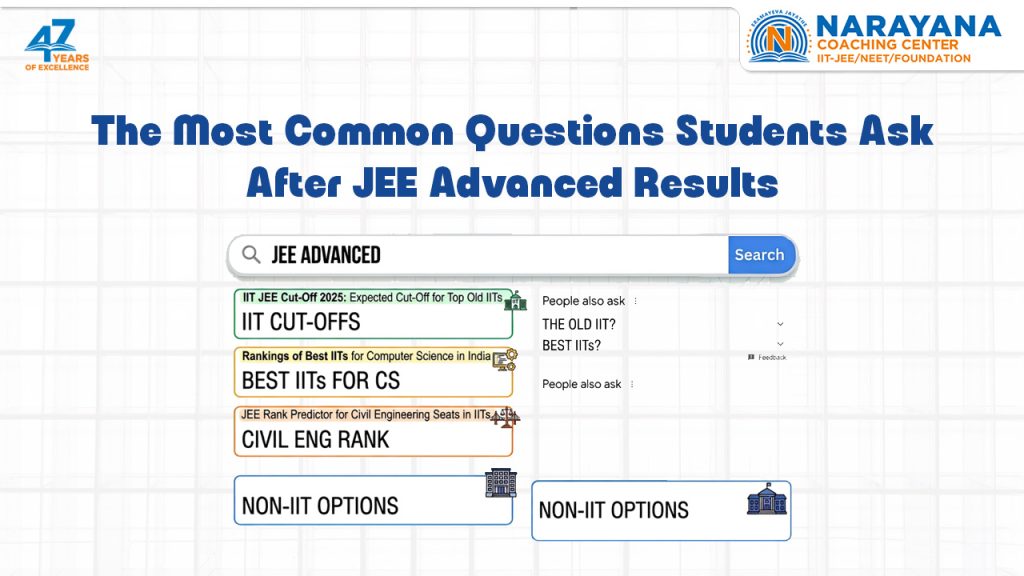
The day JEE Advanced results are announced is full of emotions. For some students, it brings joy, relief, and celebration. For others, it brings confusion, disappointment, or anxiety about what to do next. Even students who get a good rank often feel unsure because the result is not the end of the journey. It is the beginning of another important decision-making phase.
At this stage, students usually have many questions. “Will I get an IIT?” “Which branch should I choose?” “Should I take a drop?” “What if my rank is not good?” “How do I deal with disappointment?” These questions are normal. In fact, asking the right questions after results is a sign that you are thinking seriously about your future.
This blog answers the most common questions students ask after JEE Advanced results. Whether you are a JEE aspirant, a NEET aspirant observing this phase, or a student planning your next academic step, this guide will help you think clearly and calmly.
1. I cleared JEE Advanced. What should I do first?
First, take a moment to appreciate your effort. Clearing JEE Advanced is not easy. It means you have worked through one of the toughest entrance exams in the country. But after the celebration, you need to shift your focus to counselling and choice filling.
Start by understanding your rank, category rank if applicable, previous year trends, and the institutes and branches that may be available to you. Do not fill choices randomly. Make a list of colleges and branches in order of your true preference. Discuss with parents, teachers, seniors, and mentors, but remember that the final decision should match your interest, comfort, and long-term goals.
2. My rank is not very high. Can I still get a good college?
Yes, a lower-than-expected rank does not mean your future is over. Many students think only the top IITs or top branches matter, but that is not true. A good engineering journey depends on many factors: the college environment, the branch, your skills, internships, projects, consistency, and how you use the next four years.
You may still get newer IITs, other branches, or strong options through other exams and institutions. Do not judge your entire future based only on one rank. Your rank opens some doors, but your effort after admission decides how far you go.
3. Should I choose college or branch?
This is one of the biggest questions after JEE Advanced results. Many students feel stuck between a famous IIT with a less preferred branch and a newer IIT or another college with a preferred branch.
There is no one-size-fits-all answer. If you are deeply interested in a branch like Computer Science, Electrical, Mechanical, Chemical, or Civil, choosing the branch may be important. But if you are unsure about your exact interest and want exposure, peer learning, clubs, research opportunities, and a strong campus environment, the institute may also matter.
Ask yourself: Can I study this branch for four years with interest? Will I be comfortable if I do not get my dream branch? Am I choosing a branch only because of placement pressure? Am I choosing a college only because of its name? Honest answers will help you make a better choice.
4. I did not clear JEE Advanced. What should I do now?
Not clearing JEE Advanced can hurt, especially after months or years of preparation. But it is important to remember that JEE Advanced is one exam, not the final judgement of your ability. Many students who do not clear Advanced still do very well through JEE Main, state colleges, private universities, other entrance exams, or later through higher studies and skill-building.
Take a short break before making decisions. Then review your options. You may consider NITs, IIITs, GFTIs, state engineering colleges, private universities, or a drop year if you strongly feel you can improve. Do not decide in panic. A calm decision after results is always better than an emotional decision made in one day.
5. Should I take a drop year?
A drop year can be helpful for some students, but it is not the right choice for everyone. Before deciding, ask yourself a few honest questions. Did I underperform because of a temporary issue, or was my preparation weak overall? Am I mentally ready to study the same syllabus again? Do I have the discipline to improve my mistakes? Will I be able to handle pressure better next time?
Take a drop only if you have a clear plan. A drop year should not be just “one more chance.” It should be a structured improvement year. You need to know what went wrong, what will change, and how you will track progress. Without a plan, the same mistakes may repeat.
6. How should I handle disappointment after results?
Disappointment is natural. You may feel sad, angry, embarrassed, or lost. But do not isolate yourself completely. Talk to someone you trust. Share what you are feeling with your parents, teacher, mentor, or friend. Sometimes, students suffer more because they keep comparing themselves with toppers, classmates, or relatives’ expectations.
Avoid spending too much time on rank comparison, social media posts, and result discussions. Your result is important, but your mental health is more important. Give yourself a few days to process the result, then slowly move towards planning. Healing and planning can happen together.
7. What if my friends got better ranks than me?
This is a very common situation. You may feel happy for your friends but sad for yourself at the same time. That does not make you selfish. It makes you human.
Remember, everyone’s journey is different. Your friend’s result does not reduce your value. Their success does not mean your failure. Instead of comparing marks, compare habits. What did they do differently? What can you learn? Use comparison only for improvement, not self-criticism.
8. How is this relevant for NEET students?
NEET students can learn a lot from the JEE Advanced result phase. After any major entrance exam, students face similar emotions and questions. “Will I get a good college?” “Should I take a drop?” “What if my score is not enough?” “How do I choose the next step?”
The biggest lesson for NEET aspirants is this: results require emotional strength as much as academic preparation. Your preparation should not only focus on marks, but also on decision-making, patience, and resilience. Whether it is JEE or NEET, the post-result phase tests your ability to stay calm and think clearly.
9. What should parents keep in mind after results?
Parents play a very important role after results. This is not the time for harsh comparisons or emotional pressure. Students are already dealing with stress. A supportive conversation can help them recover and plan better.
Instead of asking, “Why didn’t you score more?” parents can ask, “What options do we have now?” Instead of saying, “You disappointed us,” they can say, “Let us understand the next step together.” A student who feels supported is more likely to make a confident and practical decision.
10. What is the best mindset after JEE Advanced results?
The best mindset is simple: accept the result, understand your options, and take the next step with clarity. Whether your result is excellent, average, or disappointing, do not let it define your entire identity.
A rank can decide your starting point, but it cannot decide your full journey. Many students bloom after entering college. Many students discover new interests. Many students who feel behind today become successful later because they stay consistent.
So, after JEE Advanced results, do not ask only, “What did I get?” Also ask, “What can I build from here?”
Conclusion
JEE Advanced results are important, but they are not the final chapter of your story. They are a turning point. Some students will move ahead with IIT counselling. Some will explore other engineering colleges. Some will take a drop. Some will choose a completely different path. All these paths can still lead to growth and success.
The key is to avoid panic. Do not rush because of fear. Do not choose because of pressure. Understand your rank, your options, your interests, and your mental readiness. Then take a decision that gives you the best chance to grow.
Your result matters, but your response to the result matters even more.