
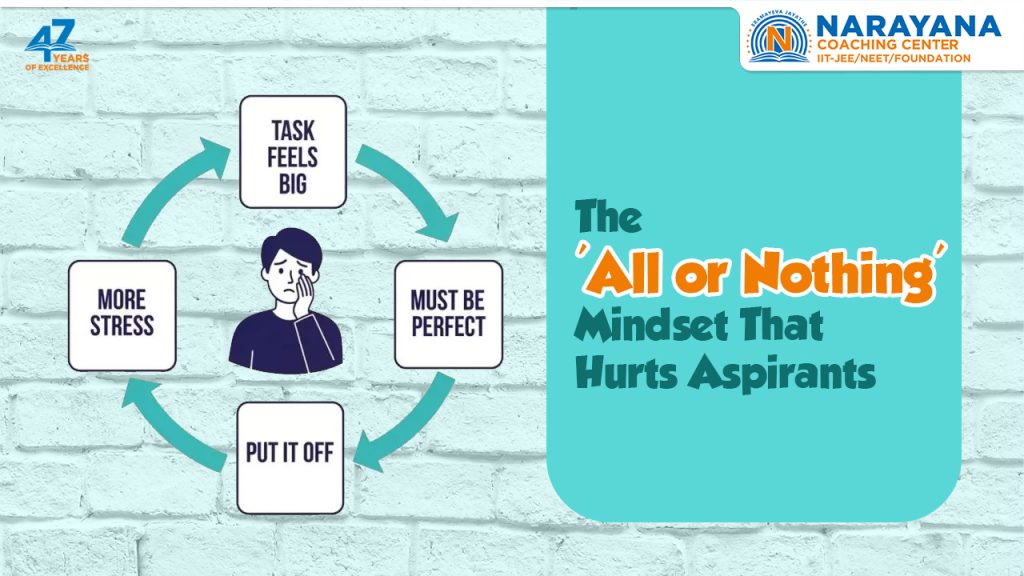
For many JEE and NEET aspirants, preparation begins with big goals and strong motivation. You make a perfect timetable, decide to study for long hours, complete every chapter on time, revise daily, solve mock tests regularly, and avoid all distractions.
For a few days, everything feels perfect.
Then one day, you wake up late. Or you fail to complete your target. Or you score badly in a mock test. Or you waste two hours scrolling on your phone.
Suddenly, your mind says, “Today is already ruined.”
So instead of doing at least some study, you do nothing. You promise yourself, “I will restart properly from tomorrow.”
This is called the all-or-nothing mindset.
It is the belief that if you cannot do something perfectly, there is no point in doing it at all. And for JEE and NEET aspirants, this mindset can silently damage preparation more than laziness itself.
What Does the All-or-Nothing Mindset Look Like?
The all-or-nothing mindset usually sounds like this:
“If I cannot study for 10 hours, the day is wasted.”
“If I missed one test, my preparation is off track.”
“If I did not revise the full chapter, there is no point revising half of it.”
“If I scored poorly in one mock test, I am not capable.”
“If I broke my timetable once, I have lost discipline.”
At first, these thoughts may look like high standards. But in reality, they create pressure, guilt, and inconsistency.
JEE and NEET preparation is not a one-day race. It is a long journey. In such a journey, no student can be perfect every single day. There will be low-energy days, difficult chapters, disappointing marks, family functions, health issues, mood swings, and unexpected distractions.
The problem is not that these things happen. The problem is when one small mistake makes you give up on the entire day, week, or month.
Why This Mindset Hurts Aspirants
The all-or-nothing mindset hurts because it turns small setbacks into big failures.
Imagine you planned to solve 100 Physics questions in a day. But because of school, coaching, or tiredness, you could solve only 30. A balanced student would say, “At least I completed 30. I will continue tomorrow.”
But an all-or-nothing thinker may say, “Only 30? This is useless. I am not serious about my preparation.”
This creates unnecessary guilt. And guilt does not improve performance. It usually leads to avoidance.
You may start avoiding mock tests because you fear low scores. You may avoid difficult chapters because you feel you must master them in one sitting. You may avoid revision because your backlog feels too large.
Slowly, the pressure to do everything perfectly prevents you from doing even the basics consistently.
Perfectionism Can Look Like Discipline
One reason this mindset is dangerous is that it can look like discipline.
For example, saying “I will study 12 hours every day without fail” sounds impressive. But if you are unable to maintain it, you may feel like a failure. A more realistic plan, like 6 focused hours with proper revision and practice, may actually give better results.
Similarly, wanting to score 700+ in NEET or 99+ percentile in JEE is not wrong. Big goals are important. But expecting every mock test to show immediate improvement is unrealistic.
Some tests will go badly. Some chapters will take longer. Some topics will need repeated revision. This does not mean you are failing. It means you are learning.
Aspirants often forget that preparation is not about feeling confident every day. It is about showing up even when the day is not perfect.
The “Restart Tomorrow” Trap
One of the biggest signs of the all-or-nothing mindset is the habit of restarting.
You miss your morning study session and say, “I will restart from tomorrow.”
You waste Sunday and say, “I will restart from Monday.”
You score poorly in a test and say, “I will restart from next month.”
You fall behind in one subject and say, “I will restart after making a new timetable.”
But serious preparation is not built by repeated restarts. It is built by quick recovery.
If you waste two hours, do not waste the whole day. Study for the next 30 minutes.
If you miss one mock test, attempt another one soon.
If you cannot complete the full chapter, complete one concept.
If you cannot solve 100 questions, solve 20 properly.
The faster you return to action, the stronger your preparation becomes.
Small Efforts Are Not Small
Many aspirants underestimate small study sessions. They think only long hours matter.
But in competitive exam preparation, small efforts add up powerfully.
Reading NCERT Biology for 20 minutes is useful.
Revising 10 formulas is useful.
Solving 15 previous-year questions is useful.
Correcting mistakes from one mock test is useful.
Watching one concept explanation and making short notes is useful.
These may look small on one day. But repeated over weeks and months, they create a strong foundation.
A student who studies imperfectly but consistently is often ahead of a student who studies perfectly for three days and then stops for four days.
Consistency beats intensity when intensity cannot be maintained.
How to Break the All-or-Nothing Mindset
The first step is to lower the entry point, not the goal.
Your goal can still be big. You can still aim for AIIMS, IIT, NIT, or a top medical college. But your daily action should feel doable.
Instead of saying, “I must finish the whole chapter today,” say, “I will finish one topic properly.”
Instead of saying, “I need to study 10 hours,” say, “I will complete three focused study blocks.”
Instead of saying, “I must score high in this mock,” say, “I will analyse every mistake honestly.”
This shift reduces pressure and increases action.
Another useful rule is the minimum study rule. Decide a minimum amount of study you will do even on a bad day. It could be 30 minutes of revision, 20 MCQs, one NCERT section, or one formula sheet.
This minimum rule keeps your chain of consistency alive. It tells your brain, “Even if today was not perfect, I did not quit.”
Progress Is Not Always Dramatic
JEE and NEET preparation often improves quietly.
You may not see results after one day of revision. You may not improve after one mock test. You may not suddenly understand Organic Chemistry or Mechanics in one sitting.
But every genuine effort leaves a mark.
Every mistake you analyse reduces the chance of repeating it.
Every question you solve improves your thinking.
Every revision makes recall faster.
Every mock test teaches you time management.
Progress is often invisible before it becomes visible.
So, do not judge your preparation only by one day, one test, or one chapter. Look at the direction. Are you returning after setbacks? Are you correcting mistakes? Are you becoming more aware of your weak areas? Are you building better habits?
That is real progress.
Replace Perfection With Recovery
Top aspirants are not perfect. They are better at recovery.
They also have bad days. They also get stuck. They also feel tired. They also score below expectations sometimes.
But they do not allow one bad moment to become a bad week.
This is the mindset every JEE and NEET aspirant needs.
Not “I must never fail.”
But “If I slip, I will come back quickly.”
Not “I must complete everything today.”
But “I will do the next useful thing.”
Not “My preparation is ruined.”
But “I can still improve from here.”
Conclusion
The all-or-nothing mindset makes you believe that only perfect effort counts. But competitive exams are not cracked by perfect days. They are cracked by repeated, honest, and steady efforts.
So the next time your day does not go as planned, do not declare it wasted.
Open your book. Solve a few questions. Revise one page. Analyse one mistake. Take one small step.
Because in JEE and NEET preparation, something is always better than nothing.
And many times, that “something” is what keeps you moving toward your dream.