
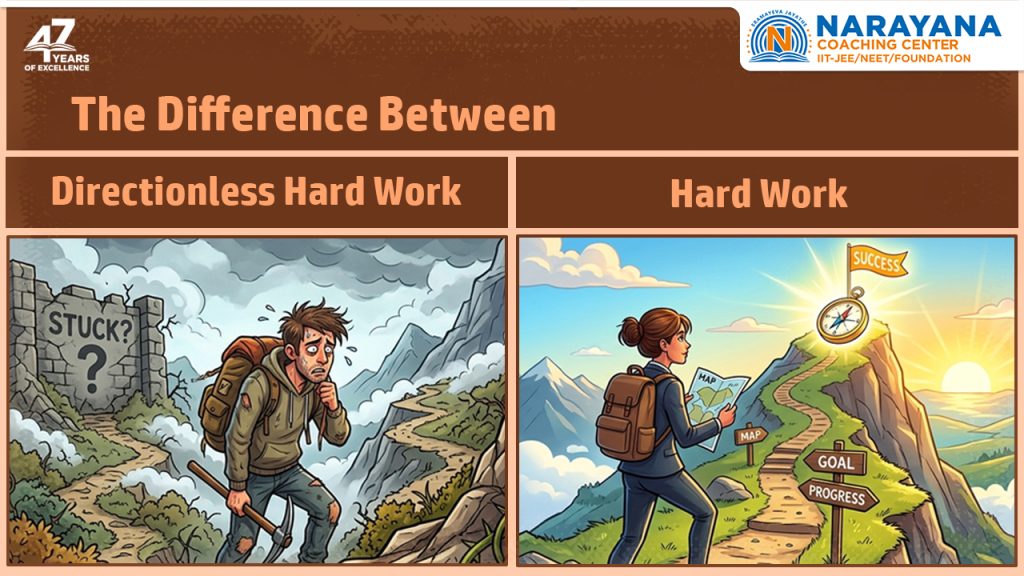
Preparing for JEE or NEET requires hard work. There is no shortcut around understanding concepts, solving questions, revising regularly, and appearing for mock tests. However, not every student who works hard gets the results they expect.
Some aspirants study for ten or twelve hours every day but still struggle to improve their scores. Others study for comparatively fewer hours yet make steady progress. The difference is often not intelligence or even effort. It is direction.
Hard work moves you forward only when it is connected to a clear goal. Without direction, even sincere effort can become exhausting, repetitive, and ineffective.
What Is Directionless Hard Work?
Directionless hard work means putting in a lot of effort without knowing whether that effort is solving your actual problems.
For example, a student may repeatedly read chapters they already understand because reading feels productive. However, they may continue avoiding difficult topics, numerical problems, mock tests, or error analysis. The student is busy, but the preparation is not improving where it matters.
Directionless hard work may look like:
- Studying for long hours without daily or weekly targets
- Collecting multiple books and resources without completing any one of them
- Revising favourite chapters while avoiding weak topics
- Solving questions without checking or analysing mistakes
- Watching long lectures without practising independently
- Giving mock tests without reviewing incorrect answers
- Following another student’s timetable without considering personal needs
These activities may require time and effort, but they do not always lead to meaningful progress.
What Does Purposeful Hard Work Look Like?
Purposeful hard work begins with clarity.
A student knows what needs to be improved, chooses suitable resources, creates realistic targets, and regularly checks whether the strategy is working. The focus is not simply on completing study hours. It is on achieving specific learning outcomes.
Instead of saying, “I will study Physics for three hours,” a purposeful student might say:
“Today, I will revise Newton’s laws, solve 40 mixed questions, and analyse every incorrect answer.”
The second goal provides direction. It clearly defines the topic, task, practice level, and expected outcome.
Purposeful preparation connects every activity to a larger objective.
Hard Work Counts Hours; Direction Counts Progress
Many aspirants judge their preparation by the number of hours they study. Study hours can help maintain discipline, but hours alone do not reveal the quality of preparation.
A student may sit at a desk for eight hours while frequently checking the phone, switching resources, rereading notes, or worrying about the syllabus. Another student may complete five focused hours involving concept revision, timed practice, and mistake analysis.
The second student is more likely to improve because the work produces evidence of learning.
Instead of asking only, “How many hours did I study?” ask:
- What did I understand today?
- How many quality questions did I solve?
- Which mistakes did I identify?
- Did I improve in a weak area?
- Can I recall the concept without looking at my notes?
These questions shift your attention from time spent to progress made.
Directionless Hard Work Avoids Discomfort
One of the biggest signs of directionless preparation is the tendency to stay within comfortable topics.
You may enjoy Organic Chemistry but avoid Rotation. You may repeatedly practise Biology chapters you remember well while postponing difficult sections of Plant Physiology. You may solve familiar Mathematics problems but skip questions that require deeper reasoning.
This still feels like studying. However, improvement usually happens when you work on areas that challenge you.
Purposeful hard work does not mean studying only difficult topics. It means maintaining strong areas while systematically improving weaker ones.
Create a weekly list containing:
- Topics you understand well
- Topics that need revision
- Topics you consistently avoid
The third category deserves special attention. Avoided chapters often become major sources of stress and lost marks later.
Resources Cannot Replace a Clear Strategy
JEE and NEET aspirants have access to countless books, video lectures, test series, notes, question banks, and online platforms. Having choices is helpful, but using too many resources can scatter your attention.
Directionless hard work often involves moving from one resource to another whenever a topic feels difficult. This creates the illusion that the next book, teacher, or course will solve the problem.
In reality, frequent switching prevents depth and consistency.
Choose a limited set of reliable resources. For NEET, NCERT—especially for Biology and Inorganic Chemistry—must remain central. For JEE, concept clarity should be followed by graded problem-solving and previous-year questions.
Complete, revise, and practise from your chosen resources before adding new ones.
Mistake Analysis Gives Hard Work a Direction
Solving hundreds of questions is useful only when you learn from the questions you get wrong.
After every test or practice session, classify your mistakes:
- Conceptual error
- Calculation error
- Misreading the question
- Incorrect formula or approach
- Guesswork
- Time-management issue
- Lack of revision
This classification tells you what action to take.
A conceptual error requires relearning. A calculation error requires careful practice. A memory-based mistake requires revision. A time-management problem may require timed sectional tests.
Without this analysis, students often repeat the same mistakes while increasing their study hours. That is a classic example of directionless hard work.
Your Plan Must Be Flexible
Having direction does not mean following a rigid timetable regardless of results. A good strategy must change according to your performance.
Suppose you planned to complete a chapter in two days, but a practice test shows that your fundamentals are weak. Spending additional time on the chapter is not failure. It is a sensible adjustment.
Similarly, when a method does not improve your scores after consistent effort, review it. You may need more revision, different question levels, shorter study sessions, or better test analysis.
Purposeful students do not remain loyal to ineffective methods. They remain loyal to their goals.
How to Turn Effort into Effective Preparation
Before beginning each study session, define one measurable outcome. At the end of the session, check whether it was achieved.
Create weekly priorities rather than filling every hour of the day. Include concept learning, question practice, revision, previous-year questions, and tests.
Maintain an error notebook or digital record. Revisit it regularly so that mistakes become lessons rather than repeated patterns.
Most importantly, review your progress every week. Compare test scores, accuracy, speed, syllabus coverage, and confidence across chapters. These indicators will show whether your hard work is moving in the right direction.
Conclusion
Hard work is essential for JEE and NEET, but hard work alone is not a complete strategy.
Directionless hard work can leave you tired without making you better prepared. Purposeful hard work, on the other hand, helps you identify weaknesses, choose priorities, analyse mistakes, and measure improvement.
You do not need to prove your dedication by studying endlessly. You need to use your time in a way that brings you closer to your target.
Remember:
Hard work is the energy you invest. Direction determines where that energy takes you.
Work sincerely, but pause regularly to ask whether your current actions are producing the progress you need. When effort and direction come together, preparation becomes more focused, confidence improves, and every study session begins to matter.