
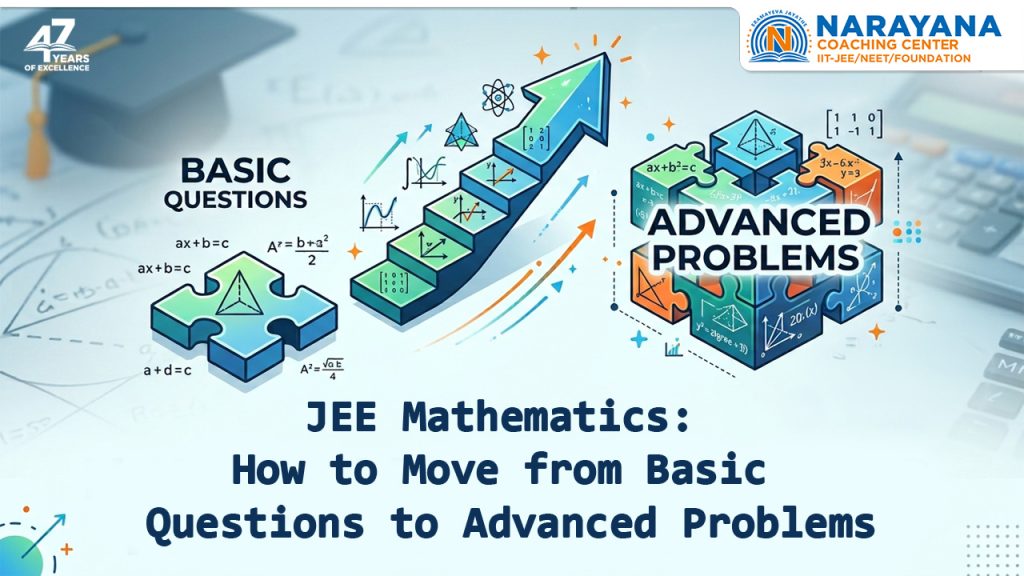
Mathematics is often considered one of the most challenging parts of JEE preparation. Many students can solve direct formula-based questions but struggle when the same concept appears in a complex or unfamiliar form. This creates a common doubt: “I understand the chapter, so why can’t I solve advanced problems?”
The reason is simple. Understanding a concept and applying it under multiple conditions are two different skills.
Advanced problem-solving does not develop by attempting the toughest questions from the beginning. It develops through a gradual process of building concepts, recognising patterns, connecting ideas, and learning from mistakes. Here is how you can move systematically from basic questions to advanced JEE Mathematics problems.
1. Build Conceptual Clarity First
Before solving difficult questions, make sure you understand the fundamental concepts of the chapter.
For every topic, you should be able to explain:
- The meaning of the formula
- The conditions under which it can be used
- The relationship between different variables
- The common exceptions or special cases
- The graphical or geometrical interpretation, wherever applicable
For example, memorising the formula of a quadratic equation is not enough. You should also understand the role of the discriminant, the nature of roots, the relationship between roots and coefficients, and the graph of a quadratic function.
Advanced questions often test these connections rather than direct formula application.
Do not rush through theory just to start solving questions. A strong conceptual base reduces confusion when problems become more complex.
2. Follow a Question-Level Progression
Your practice should move through clearly defined levels.
Level 1: Direct Concept-Based Questions
Begin with questions that test a single formula or concept. These problems help you check whether you understand the basic definitions and methods.
At this stage, focus on:
- Correct formula selection
- Accurate calculations
- Proper mathematical steps
- Understanding why the method works
Avoid dismissing basic questions as “too easy.” They build the accuracy and confidence required for higher-level problems.
Level 2: Standard Application Questions
Once you are comfortable with direct questions, move to problems that require two or more steps.
These questions may involve:
- Combining two formulas
- Identifying hidden information
- Applying a concept in a slightly modified form
- Choosing between multiple possible methods
This stage teaches you how to interpret questions instead of simply reacting to familiar formats.
Level 3: Mixed-Concept Problems
Advanced JEE questions often combine concepts from different chapters.
For instance, a coordinate geometry question may involve quadratic equations. A calculus problem may require knowledge of functions, inequalities, or trigonometry. A probability question may involve permutations and combinations.
Practising mixed-concept questions trains your mind to identify which ideas are connected.
Level 4: Advanced and Unfamiliar Problems
Only after gaining confidence in the earlier levels should you attempt challenging questions from JEE Advanced-level material, high-quality test series, and previous years’ papers.
At this stage, the goal is not to solve every question immediately. The goal is to develop deeper thinking, method selection, and persistence.
3. Learn to Read Questions Carefully
Many students begin calculating before fully understanding the question. This often leads to unnecessary work or incorrect assumptions.
Before solving, ask yourself:
- What information is given?
- What exactly must be found?
- Which chapter or concept does the question relate to?
- Are there any restrictions or conditions?
- Can the problem be represented through a graph, diagram, table, or equation?
Spend a few seconds planning before writing equations. This habit becomes especially important in lengthy or multi-concept problems.
Advanced Mathematics is not only about calculation speed. It is also about correctly interpreting the problem.
4. Try More Than One Method
When you solve a question, do not always stop after obtaining the answer.
Ask whether the same problem can be solved using another method.
For example, a question may be solved through:
- Algebraic manipulation
- Graphical interpretation
- Substitution
- Elimination
- Symmetry
- Mathematical inequalities
- A geometrical approach
- Option-based reasoning
Exploring alternate methods improves flexibility. It also helps you select the fastest method during the actual examination.
However, do not force multiple methods for every question. Use this exercise mainly for important, tricky, or representative problems.
5. Use Hints Instead of Reading Full Solutions
When you are unable to solve a question, avoid checking the complete solution immediately.
First, try to identify where you are stuck.
You may need help with:
- Selecting the correct concept
- Forming the first equation
- Simplifying an expression
- Recognising a substitution
- Connecting the problem to a known result
Look for a small hint and attempt the problem again. This keeps your brain actively involved in the solution process.
Reading a complete solution may create the illusion that you have understood the problem. Real understanding comes when you can reproduce the approach independently.
After studying a solution, close the book and solve the question again without assistance.
6. Maintain an Error Notebook
Your mistakes are valuable indicators of what needs improvement.
Maintain a separate Mathematics error notebook and classify mistakes into categories such as:
- Conceptual misunderstanding
- Incorrect formula
- Calculation error
- Missed condition
- Wrong interpretation
- Incomplete solution
- Inefficient method
- Time-management issue
Write down the question reference, the mistake, and the correct approach.
Review this notebook every week. You will gradually notice patterns. Perhaps you repeatedly miss domain restrictions, make sign errors, or struggle to recognise substitutions.
Correcting recurring errors can improve your score faster than solving hundreds of random new questions.
7. Analyse Problems After Solving Them
After completing a difficult question, take a minute to reflect.
Ask:
- What was the key idea?
- Which step made the problem easier?
- Was there a hidden condition?
- Could I recognise a similar question in the future?
- What made the problem appear difficult?
This process converts one solved question into a reusable problem-solving pattern.
Over time, you will start recognising structures instead of seeing every question as completely new.
8. Practise Previous Years’ Questions Properly
JEE previous years’ questions are essential because they show how concepts are tested in the actual examination.
Do not solve them randomly from the beginning of your preparation. First complete the relevant chapter at a basic and moderate level. Then attempt chapter-wise JEE Main and JEE Advanced questions.
While practising, analyse:
- The concepts frequently tested
- Common question structures
- The level of calculation involved
- The importance of options
- The difference between JEE Main and JEE Advanced approaches
Previous years’ questions should be treated as learning material, not just as mock-test questions.
9. Revise Advanced Problems Regularly
A difficult problem understood today may feel unfamiliar after two weeks.
Mark important questions using categories such as:
- Conceptually important
- Tricky
- Multiple methods possible
- Frequently mistaken
- Worth revising before tests
Revisit these questions after a few days and solve them without looking at the solution.
Revision strengthens pattern recognition and prevents you from repeatedly learning the same idea from the beginning.
10. Balance Speed with Depth
During learning, prioritise understanding over speed. During tests, practise applying that understanding within time limits.
Begin with untimed practice for new concepts. Once you become comfortable, solve small sets under time pressure.
For example, attempt 10 to 15 mixed questions within a fixed duration. Then analyse not only how many were correct but also where your time was spent.
Speed develops naturally when concepts, patterns, and methods become familiar. Trying to become fast before becoming accurate often leads to careless mistakes.
Conclusion
Moving from basic to advanced JEE Mathematics problems is not a sudden jump. It is a gradual progression.
Start with conceptual clarity. Solve direct questions, move to standard applications, practise mixed concepts, analyse mistakes, and revise challenging problems regularly. Most importantly, do not judge your ability based on one difficult question.
Every advanced problem becomes manageable when it is broken into familiar concepts and smaller steps.
The goal is not to solve the highest number of questions. The goal is to learn something from every question you solve. With structured practice, patience, and consistent analysis, your ability to handle advanced JEE Mathematics problems will steadily improve.
The blog can also be adapted into a concise wall copy and social-media caption with relevant hashtags.