
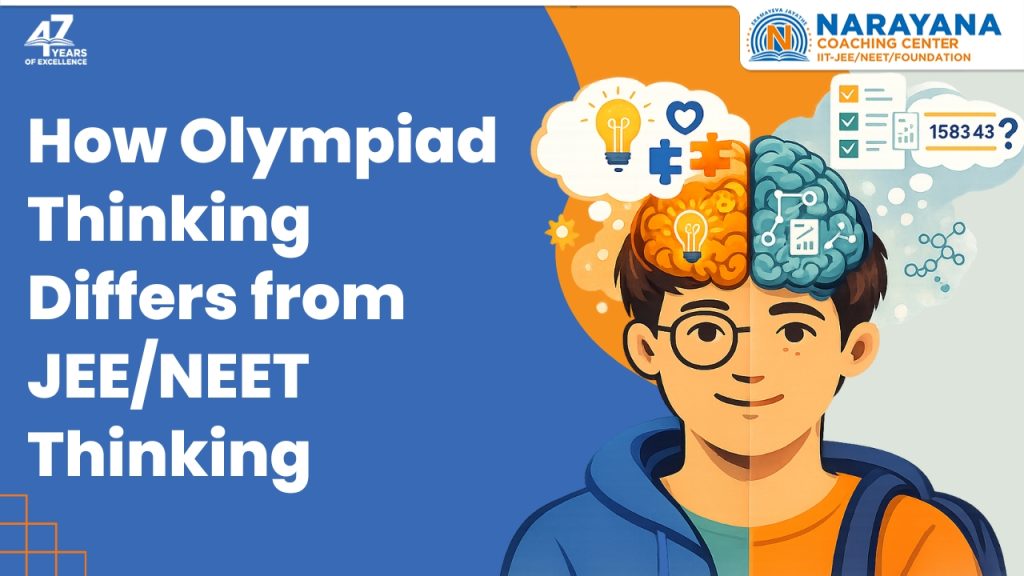
In India’s competitive exam ecosystem, students often hear advice like “Olympiad students do better in JEE” or “If you crack Olympiads, NEET will be easy.” While there is some truth in these statements, they also hide an important reality: Olympiad exams and JEE/NEET test very different kinds of thinking.
Understanding this difference is crucial—not just for students, but also for parents and teachers guiding them. Confusing the two can lead to frustration, burnout, or ineffective preparation. This blog breaks down how Olympiad thinking differs fundamentally from JEE/NEET thinking, and how students can benefit from both.
1. The Core Objective: Exploration vs Selection
At the heart of the difference lies why these exams exist.
Olympiads are designed to identify mathematical or scientific talent—students who can think deeply, creatively, and independently. They are closer to the mindset of research and problem discovery.
JEE and NEET, on the other hand, are selection exams. Their goal is to rank lakhs of students fairly and efficiently for limited seats in engineering and medical colleges. The focus is on consistency, coverage, an d speed.
In simple terms:
- Olympiads ask, “How deeply can you think?”
- JEE/NEET asks, “How reliably can you perform under pressure?”
2. Nature of Problems: Open-Ended vs Structured
Olympiad Problems
Olympiad questions often:
- Look unfamiliar at first glance
- Cannot be solved using a standard formula
- Require constructing ideas from scratch
- Have elegant but non-obvious solutions
A single Olympiad problem may require:
- Multiple insights
- Logical deductions
- Trying, failing, and retrying
Even strong students may spend 30–60 minutes on one question.
JEE/NEET Problems
JEE and NEET problems are:
- Based strictly on the syllabus
- Highly structured
- Designed to be solvable in 1–3 minutes
They test whether you:
- Recognise the concept quickly
- Apply the correct method
- Avoid calculation errors
Here, recognition beats reinvention.
3. Thinking Style: Depth vs Speed
This is perhaps the biggest mental shift students struggle with.
Olympiad Thinking
- Slow, deliberate, and exploratory
- Encourages asking “Why does this work?”
- Rewards original approaches
- Comfort with uncertainty is essential
You are expected to sit with a problem, explore patterns, and build intuition.
JEE/NEET Thinking
- Fast, decisive, and tactical
- Encourages asking “Which formula applies here?”
- Rewards accuracy under time pressure
- Minimal tolerance for hesitation
Here, hesitation costs marks.
4. Relationship with the Syllabus
Olympiads: Syllabus Is a Starting Point
Olympiads often:
- Go beyond NCERT
- Mix topics creatively
- Use elementary ideas in advanced ways
A student might need concepts from:
- Higher mathematics
- Advanced number theory
- Logical reasoning not explicitly taught in school
The syllabus is flexible, and depth matters more than breadth.
JEE/NEET: Syllabus Is the Boundary
JEE and NEET:
- Are tightly aligned to NCERT
- Penalise out-of-syllabus thinking
- Reward thorough coverage of defined content
Skipping even one chapter can significantly reduce rank potential.
5. Role of Memory vs Insight
Olympiad preparation relies far less on memory and far more on:
- Pattern recognition
- Conceptual understanding
- Logical sequencing
Memorising formulas alone is rarely useful.
JEE/NEET preparation, while still conceptual, requires:
- Strong recall of formulas
- Standard result familiarity
- Repeated practice to build speed
Memory supports performance, even though understanding remains important.
6. Error Tolerance and Marking Style
Olympiads usually:
- Have fewer questions
- Offer high weightage per problem
- Allow partial credit in some stages
A single brilliant idea can fetch full marks.
JEE/NEET:
- Have many questions
- Penalise mistakes heavily (negative marking)
- Offer no reward for partial reasoning
A small calculation slip can undo a correct understanding.
7. Preparation Strategy: Exploration vs Optimisation
Olympiad Preparation
Effective Olympiad prep includes:
- Solving fewer problems, but deeply
- Analysing solutions thoroughly
- Learning from failures
- Reading solution write-ups
Progress is slow but intellectually rewarding.
JEE/NEET Preparation
Effective JEE/NEET prep includes:
- Massive question practice
- Mock tests and analysis
- Time management drills
- Strategy refinement
The goal is optimisation, not exploration.
8. Psychological Mindset Required
Olympiads demand:
- Patience
- Curiosity
- Comfort with struggle
- Intrinsic motivation
Students must enjoy thinking—even when they don’t succeed.
JEE/NEET demand:
- Discipline
- Resilience
- Emotional control
- Performance consistency
The pressure is external and intense.
9. Should Students Choose One Over the Other?
This is a common misconception. Olympiads and JEE/NEET are not rivals—they are complements.
Olympiads:
- Build deep conceptual strength
- Improve logical thinking
- Create long-term academic confidence
JEE/NEET:
- Teach discipline and execution
- Prepare students for competitive environments
- Reward systematic preparation
Students who balance both gain:
- Depth from Olympiads
- Speed and accuracy from JEE/NEET
However, the preparation style must differ. Treating Olympiads like JEE mock tests—or JEE like Olympiad puzzles—often leads to poor outcomes.
10. Conclusion
Olympiad thinking is about discovering ideas.
JEE/NEET thinking is about deploying ideas efficiently.
One nurtures thinkers.
The other selects performers.
Understanding this distinction helps students:
- Set realistic expectations
- Choose the right preparation methods
- Avoid unnecessary stress
When approached correctly, Olympiads sharpen the mind, and JEE/NEET sharpen performance. Together, they can create not just successful exam-takers—but strong problem-solvers for life.