
Cracking competitive exams like JEE and NEET isn’t just about studying hard—it’s about studying smart. You may have experienced moments where you studied a chapter thoroughly, solved questions, and felt confident—only to forget most of it a week later. This isn’t your fault. It’s simply the way the human brain works.
This natural decline in memory is explained by a well-established scientific principle called the forgetting curve. Understanding this curve can completely transform the way you revise, enabling you to retain concepts for longer and perform better on exam day.
In this blog, we explain the science behind forgetting and give you a clear, actionable strategy to help you revise at the right time.
What Is the Forgetting Curve?
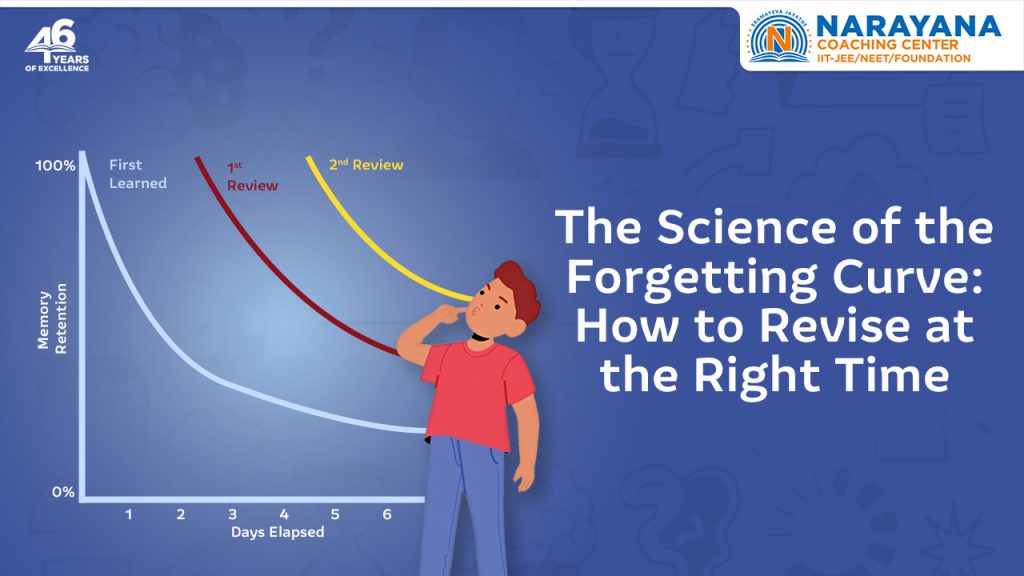
The forgetting curve was discovered by the German psychologist Hermann Ebbinghaus, who found that our memory fades rapidly after we learn something new. In fact, within 24 hours, students can forget over 50% of what they learnt—unless they revise it.
The graph of the forgetting curve slopes sharply downward after initial learning and then gradually levels out. This means you forget the most immediately after studying, and the rate of forgetting slows over time.
For JEE and NEET students, this is especially relevant because:
- You learn a large volume of information every day.
- You constantly switch between subjects like physics, organic chemistry, and biology.
- Many concepts build on earlier topics, so forgetting them can impact future understanding.
If you don’t revise topics regularly, the brain treats them as unimportant and begins to discard them to make space for new information.
Why Do We Forget? The Science Behind It
There are three major reasons why the brain forgets information:
1. Memory Decay
If you don’t revisit what you learnt, the neural connections weaken with time. This is the most common reason aspirants forget formulae, reactions, or diagrams.
2. Interference
New information interferes with older information. After learning a new set of chemistry reactions, for instance, you may find it difficult to recall the previous ones.
3. Retrieval Failure
Sometimes the information is stored, but you can’t access it because you never practised recalling it. This is why self-testing is much more effective than rereading notes.
Why Revising at the Right Time Matters for JEE & NEET
Revision isn’t just repetition—it’s reinforcement. When you revise concepts at the correct intervals, your forgetting curve rises again, helping you retain information for a longer period.
For aspirants, timely revision helps to:
- Strengthen memory pathways
- Build long-term retention
- Reduce exam stress
- Improve accuracy in tests
- Prevent forgetting when a topic reappears months later
A planned revision strategy ensures that nothing slips through the cracks.
How to Break the Forgetting Curve Using Spaced Repetition
The most powerful method to improve retention is spaced repetition—revising topics at increasing time gaps. This approach aligns perfectly with the way the brain naturally stores information.
The general idea is simple:
Revise just when you’re about to forget.
Each revision flattens the forgetting curve, dramatically improving retention.
The Ideal Revision Schedule: The 1-3-7-15 Method
The easiest and most effective revision pattern for JEE and NEET students is the 1-3-7-15 formula.
Day 1 – First Revision
Revisit the chapter within 24 hours of learning it. This step is crucial.
Day 3 – Quick Recap
Go through your notes, formulae, and important diagrams. Try solving 10–15 questions.
Day 7 – Practice-Based Revision
Attempt a chapter test, PYQs, or mixed questions. This boosts retrieval ability.
Day 15 – Final Reinforcement
Complete a deeper revision followed by problem-solving. By this point, your retention may rise to nearly 80–90%.
Following this pattern ensures concepts remain fresh without overwhelming you.
Smart Revision Techniques for JEE & NEET Aspirants
Here are the most effective, scientifically proven strategies to maximise retention:
1. Active Recall
Instead of rereading, close your book and try to recall everything you can.
Ask yourself:
- What is the concept?
- Why does it work this way?
- Can I explain it in simple words?
Active recall strengthens memory far more effectively than passive reading.
2. Spaced Repetition Apps
Tools like Anki, Quizlet, and SuperMemo help automate revision cycles.
They work extremely well for:
- Organic chemistry reactions
- Biology definitions
- Physics formulae
- Important facts from NCERT
3. Practice Questions and Mock Tests
Solving questions reinforces learning through retrieval.
Try to solve:
- NCERT back exercises
- PYQs
- Topic-wise question banks
- Weekly full-length tests
The more you test yourself, the stronger your memory becomes.
4. Teach Someone Else
This is called the Feynman Technique.
When you explain a concept to a friend—or even to yourself—you identify gaps in understanding and strengthen your recall.
Common Revision Mistakes You Must Avoid
Many students revise, but not effectively. Avoid these traps:
❌ Rereading without testing yourself
This feels productive, but results in poor retention.
❌ Ignoring weak areas
Revise difficult chapters more frequently.
❌ Starting revision too late
Revision is not a last-minute activity—it must begin on Day 1.
❌ Not making short notes
Short notes help you revise faster and more effectively.
Conclusion
The forgetting curve is a powerful reminder that learning on its own isn’t enough. What truly matters is retaining what you learn—and this requires smart, timely revision. By using spaced repetition, active recall, and the 1-3-7-15 method, JEE and NEET aspirants can strengthen memory, reduce stress, and achieve higher scores with the same amount of effort.
Remember:
It’s not about studying more—it’s about studying at the right time.
FAQs About the Forgetting Curve for JEE & NEET
1. How many times should I revise for JEE/NEET?
Aim for at least three to four thorough revisions before the exam, followed by quick revisions in the final week.
2. Does the forgetting curve affect biology more than physics?
Yes. Biology contains more factual information, which fades more quickly without regular revision.
3. Can mock tests improve memory?
Absolutely. They strengthen retrieval and reinforce concepts effectively.
4. Is spaced repetition better than daily revision?
Yes. Spaced repetition aligns with how the brain stores information and significantly improves long-term memory.
5. What if I fall behind on the 1-3-7-15 schedule?
Simply revise as soon as you can—there is no need to restart the schedule from the beginning.
6. Are coaching institute modules enough for revision?
They provide a strong foundation, but you should supplement them with short notes and self-testing.