
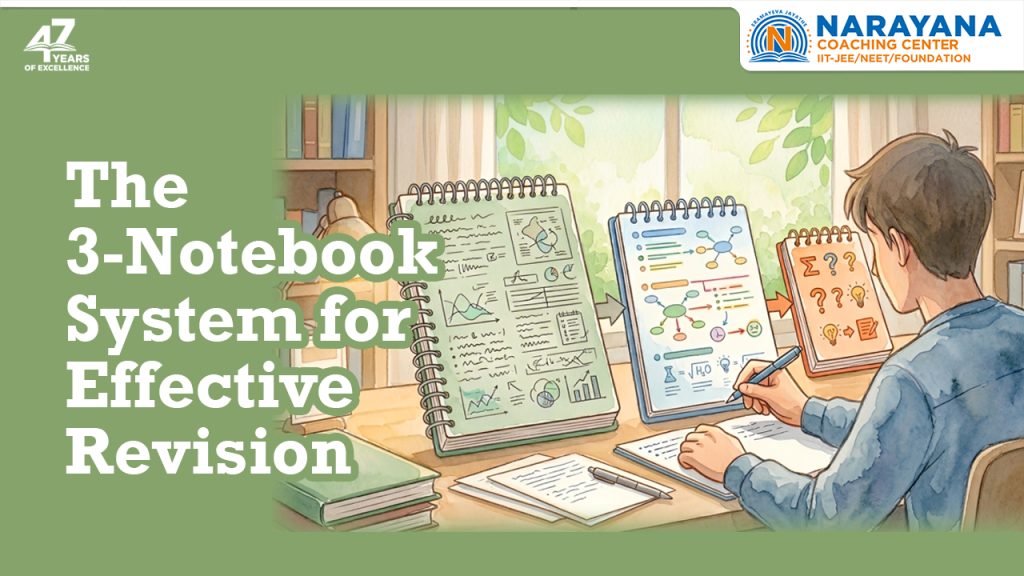
NEET preparation is not just about how much you study. It is also about how well you revise. Many students attend classes, solve questions, take mock tests, and read NCERT again and again, but still feel that concepts are slipping away. The reason is simple: without a proper revision system, your preparation becomes scattered.
You may have underlined your textbook, saved PDFs, written formulas in rough notebooks, and marked mistakes in test papers. But when the exam comes closer, you may not know where to look first. This creates confusion, stress, and last-minute panic.
That is where the 3-Notebook System can help.
This system is simple, practical, and especially useful for NEET students because it helps you organize your revision into three clear parts: concepts, mistakes, and final quick revision. Instead of revising randomly, you revise with purpose.
Why NEET Students Need a Revision System
NEET has a huge syllabus. Physics requires conceptual clarity and formula application. Chemistry needs theory, reactions, exceptions, and numerical practice. Biology demands strong NCERT-based memory and repeated recall.
If you study without a system, three problems usually happen.
First, you keep forgetting old chapters while studying new ones. Second, you repeat the same mistakes in tests. Third, before the exam, you waste time deciding what to revise.
A good revision system solves these problems. It gives every important point a proper place. When your notes are organized, your brain feels less overloaded. You know exactly what to revise, when to revise, and how to revise.
The 3-Notebook System divides your preparation into:
Notebook 1: Concept Notebook
Notebook 2: Mistake Notebook
Notebook 3: Final Revision Notebook
Let us understand each one in detail.
Notebook 1: The Concept Notebook
The Concept Notebook is for understanding. This is where you write the core ideas of every chapter in your own words.
Many students make the mistake of copying full textbook paragraphs into their notes. That does not help much. Your Concept Notebook should not become another bulky textbook. It should be a simplified version of what you have understood.
For Biology, write important NCERT lines, diagrams, cycles, tables, examples, and confusing terms. For example, in Human Physiology, you can make flowcharts for digestion, respiration, blood circulation, and hormonal control.
For Chemistry, write mechanisms, reactions, periodic trends, exceptions, important formulas, and short explanations. In Organic Chemistry, you can note down reaction types and conversion patterns. In Inorganic Chemistry, NCERT-based facts and exceptions are very important.
For Physics, write formulas, conditions, units, graphs, and key concepts. Along with formulas, always write when and where they are used. A formula without context is difficult to apply in NEET questions.
The purpose of this notebook is to help you revise a chapter quickly without opening five different sources. When you revise from this notebook, you should feel, “Yes, I understand this chapter.”
Notebook 2: The Mistake Notebook
This is the most powerful notebook in the system.
The Mistake Notebook is where you record every important mistake you make in practice questions, tests, and mock exams. NEET selection depends not only on learning new things but also on reducing repeated mistakes.
Whenever you solve a test, do not just check your score and move on. Spend time analyzing your mistakes. Ask yourself:
Was it a concept error?
Was it a calculation mistake?
Was it due to confusion between two options?
Was it because I forgot an NCERT line?
Was it a silly mistake due to hurry?
Write the question reference, the topic, your wrong approach, the correct approach, and the lesson learned.
For example:
Chapter: Current Electricity
Mistake: Used series resistance formula instead of parallel resistance formula.
Reason: Did not observe the circuit carefully.
Correction: First identify whether resistors are in series or parallel before applying the formula.
For Biology, your mistake note may look like this:
Chapter: Biological Classification
Mistake: Confused cyanobacteria with bacteria and algae.
Correction: Cyanobacteria are photosynthetic prokaryotes and are included under Monera.
This notebook helps you understand your personal weak areas. Two students may study the same chapter, but their mistakes may be different. Your Mistake Notebook becomes your customized improvement guide.
Before every mock test, revise this notebook. It will remind you of the traps you usually fall into. Over time, your accuracy will improve because you are not just studying more; you are correcting yourself better.
Notebook 3: The Final Revision Notebook
The Final Revision Notebook is for speed. This is the notebook you will use during the final months, final weeks, and final days before NEET.
It should contain only the most important and high-yield points. Think of it as your emergency revision tool.
This notebook should include:
Important formulas
Frequently forgotten facts
NCERT one-liners
Important diagrams
Reaction summaries
Common exceptions
Tricky concepts
Last-minute memory points
For Biology, include facts that are easy to forget but often asked. For example, examples of plant families, hormones, diseases, genetic disorders, ecological terms, and biotechnology tools.
For Chemistry, include named reactions, colour changes, exceptions in periodic trends, important ores, coordination compounds, and formulas.
For Physics, include formula sheets, graphs, units, dimensions, and common question patterns.
The rule is simple: do not overload this notebook. If everything is important, nothing is important. This notebook should be short enough to revise quickly and strong enough to give you confidence before tests.
How to Use the 3-Notebook System Weekly
Having three notebooks is not enough. You must use them regularly.
After learning a chapter, update your Concept Notebook. After solving questions or tests, update your Mistake Notebook. At the end of every week, pick the most important points from both and add them to your Final Revision Notebook.
You can follow this simple weekly pattern:
From Monday to Friday, focus on learning concepts and solving questions. On Saturday, analyze mistakes and update your Mistake Notebook. On Sunday, revise old chapters and update your Final Revision Notebook.
This routine prevents backlog. It also ensures that revision becomes a habit, not a last-minute burden.
Digital or Physical Notebooks?
Both are fine. Some students prefer physical notebooks because writing improves memory and feels more personal. Others prefer digital notes because they are easy to edit, search, and organize.
For NEET preparation, physical notebooks often work better for formulas, diagrams, and quick revision. But you can also use digital tools for storing test screenshots, PDFs, and chapter-wise mistake lists.
The best method is the one you can follow consistently.
Common Mistakes to Avoid
Do not make your notebooks too decorative. NEET does not reward beautiful notes; it rewards clear thinking and accurate answers.
Do not copy everything from coaching modules. Write only what helps you revise.
Do not ignore the Mistake Notebook. Many students maintain concept notes but never track mistakes. This is why their scores remain stuck.
Do not create the Final Revision Notebook too late. Start building it early so that it becomes useful during the final phase.
Most importantly, do not write notes and forget them. A notebook becomes valuable only when you revise it repeatedly.
Conclusion
The 3-Notebook System is not complicated, but it is powerful. It gives structure to your NEET revision and helps you study with more clarity.
Your Concept Notebook builds understanding. Your Mistake Notebook improves accuracy. Your Final Revision Notebook increases speed and confidence.
NEET preparation can feel overwhelming because the syllabus is vast and competition is high. But when your revision is organized, your preparation becomes calmer and more focused. You stop asking, “Where should I revise from?” and start saying, “I know exactly what to revise today.”
Remember, the goal is not to make more notes. The goal is to make notes that help you remember, correct, and perform.
Study smart, revise regularly, and let your notebooks become your strongest revision partners.