
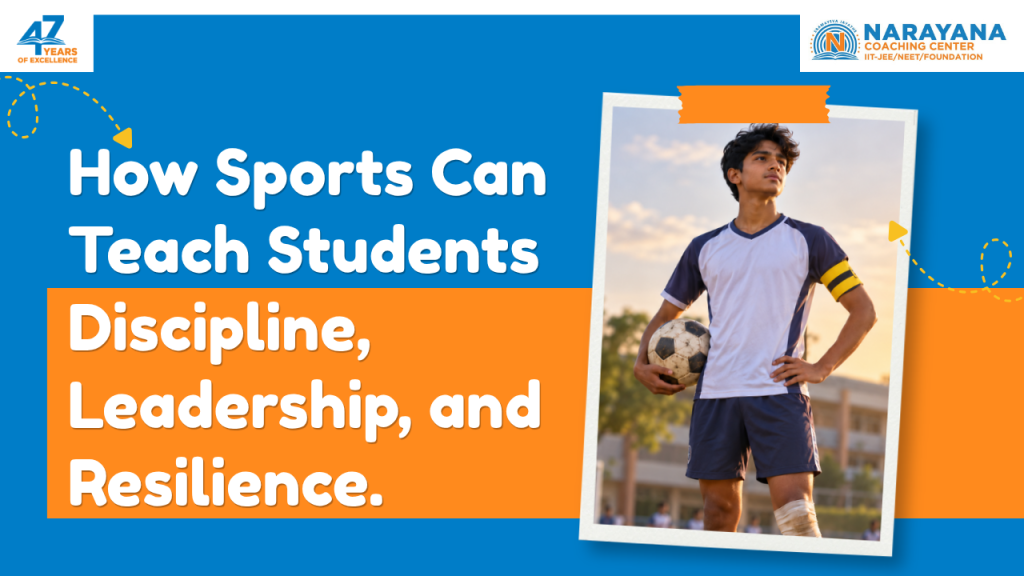
For students, sports are often seen as a way to stay active, have fun, and participate in competitions. But the lessons learned on a sports field, court, track, or swimming pool can go far beyond physical fitness.
Every practice session, difficult match, missed opportunity, and hard-earned victory can teach students valuable life skills. Sports encourage young people to set goals, manage their time, work with others, handle pressure, and keep going when things do not go as planned.
Three qualities stand out in particular: discipline, leadership, and resilience. These qualities can help students not only in sports but also in academics, relationships, and future careers.
1. Sports Teach the Power of Discipline
Success in sports rarely happens overnight. Athletes improve through regular practice and commitment.
A student learning football, basketball, athletics, swimming, or any other sport needs to practise consistently. Sometimes, this means training even when they are not particularly motivated.
This teaches an important lesson: motivation may get you started, but discipline helps you continue.
The same principle applies to academics. A student may not feel like studying every day, but developing a regular study routine can gradually improve performance.
Sports can also teach students to follow schedules, arrive on time, follow rules, and take responsibility for their preparation. These habits can make it easier to manage schoolwork and other responsibilities.
2. Sports Help Students Set Goals
Every athlete has something to work towards.
It could be running faster, improving a skill, scoring more goals, learning a new technique, or helping the team win a competition.
Breaking a large goal into smaller targets makes progress easier to see.
For example, a student who wants to improve their running time may first focus on improving endurance, then speed, and eventually their overall performance.
Students can apply the same approach to academics. Instead of saying, “I want to score better,” they can set specific goals such as completing a certain number of practice questions each day or improving their performance in a particular subject.
Sports teach students that progress is built step by step.
3. Sports Develop Leadership Skills
Leadership is not simply about being the captain of a team.
A good leader encourages others, takes responsibility, communicates clearly, and remains calm during challenging situations.
Team sports provide many opportunities for students to practise these skills. A player may help a teammate understand a strategy, encourage someone after a mistake, or take responsibility when the team faces a setback.
Even individual sports can develop leadership. Athletes learn to manage their own preparation, make decisions, and take ownership of their performance.
These experiences can make students more confident when taking responsibility in classrooms, school activities, projects, and future workplaces.
4. Sports Teach Teamwork and Communication
Many sports require people to work together towards a common goal.
A successful team cannot depend on one person doing everything. Players need to understand their roles, communicate with teammates, trust one another, and cooperate during challenging situations.
This teaches students that different people can contribute in different ways.
The same lesson applies to group projects at school. One student may be good at research, another at presenting ideas, and someone else at organising the work.
Sports help students understand that effective teamwork is about combining different strengths.
5. Losing Can Teach Resilience
Winning feels great, but losing can sometimes teach an even more valuable lesson.
A student may practise for weeks and still lose a match. They may miss an important shot, make a mistake, or perform below expectations.
These moments can be disappointing, but they also provide an opportunity to learn.
Students can ask:
- What went wrong?
- What could I have done differently?
- What can I practise before the next match?
- What did this experience teach me?
This process builds resilience — the ability to recover from setbacks and keep moving forward.
The same quality is essential in academics. A low test score does not have to define a student’s ability. It can become an opportunity to identify weak areas, change study strategies, and improve.
6. Sports Teach Students to Handle Pressure
Competitions can create pressure. The final minutes of a match, a crucial penalty, or a race where every second matters can test an athlete’s ability to stay focused.
Over time, students learn techniques to manage pressure, such as staying focused on the next action rather than worrying about the final result.
These skills can also be useful during examinations, presentations, interviews, and other important situations.
Instead of thinking, “What if I fail?” students can learn to focus on what they can control: preparation, concentration, and effort.
7. Sports Build Confidence
Confidence does not always come from winning.
It can come from knowing that you worked hard, improved a skill, faced a difficult challenge, or contributed to your team.
Imagine a student who initially struggles to play a particular sport but continues practising. Eventually, they master the skill they once found difficult.
That experience creates a powerful message:
“I can improve when I keep working at something.”
This confidence can influence other areas of life, including academics and social situations.
8. Sports Teach Respect and Fair Play
Sports operate on rules. Players must respect officials, opponents, teammates, and the spirit of the game.
Students learn that winning is important, but how you win matters too.
Congratulating an opponent, accepting a referee’s decision, helping an injured player, or admitting a mistake teaches values such as respect, honesty, and sportsmanship.
These values are important far beyond competition. They shape how students interact with classmates, teachers, friends, and colleagues.
9. Sports Teach Time Management
Balancing sports with schoolwork requires planning.
A student who has practice after school needs to manage homework, revision, rest, and other activities around training.
This can encourage students to become more organised. Instead of postponing tasks, they learn to plan ahead and make effective use of their time.
Learning this balance early can be valuable as students move into higher education and professional life, where managing multiple responsibilities becomes increasingly important.
10. Sports Teach Students That Improvement Takes Time
One of the most important lessons sports can offer is patience.
A beginner does not become an expert after a few practice sessions. Improvement often happens gradually, with periods of progress and occasional setbacks.
Students learn that struggling with something does not necessarily mean they are incapable of doing it.
Sometimes, it simply means they need more practice, a different strategy, or more time.
This mindset can transform the way students approach difficult subjects and challenging goals.
Conclusion
Sports are much more than games. They can become a training ground for life.
Through regular practice, students learn discipline. By working with teammates and taking responsibility, they develop leadership and teamwork. By recovering from losses and setbacks, they build resilience.
These qualities can support students in classrooms just as much as they do on the playing field.
So, whether you play competitively or simply enjoy being active, remember that every practice session and every challenge is teaching you something.
The real victory in sports is not just the medal or the score — it is the stronger, more disciplined, confident, and resilient person you become along the way.