
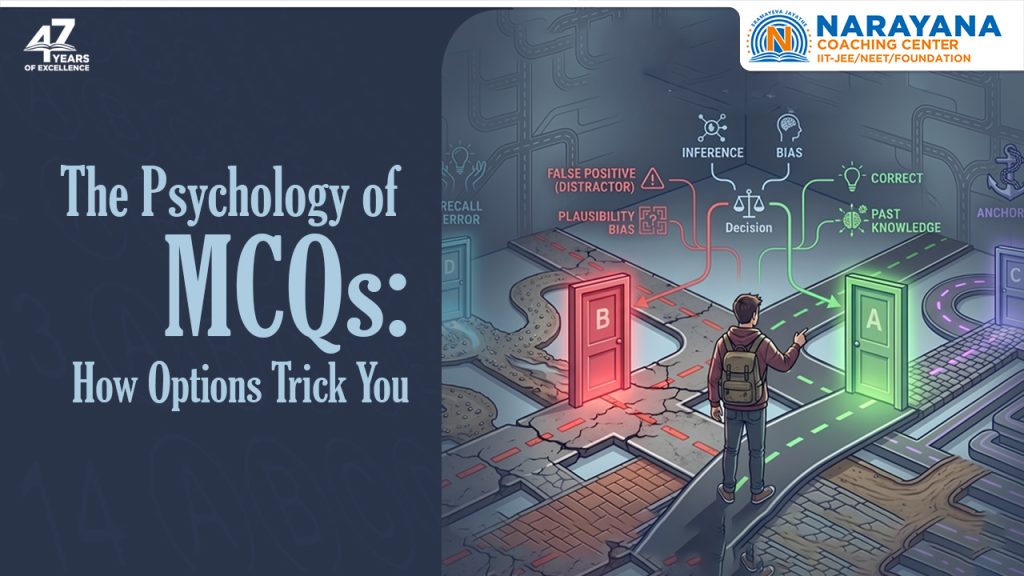
Multiple Choice Questions (MCQs) are not just about testing what you know—they are designed to test how you think. If you’ve ever walked out of a Joint Entrance Examination (JEE) feeling confident, only to lose marks to “silly mistakes,” you’ve already experienced the psychological game behind MCQs.
Let’s break this down: JEE questions don’t just assess concepts—they are crafted to exploit common thinking errors, habits, and pressure responses. Understanding this psychology can give you a serious edge.
Why MCQs Are Designed This Way
Examiners aim to differentiate between:
- Students who know the concept
- Students who almost know
- Students who are guessing
To do this, they design options (also called distractors) that look convincing. These distractors are not random—they are based on real mistakes students commonly make.
The 5 Most Common Psychological Traps in MCQs
1. The “Close Enough” Trap
You solve a Physics or Chemistry problem and get a value like 0.498, but one option says 0.5.
Your brain says: “That’s basically the same.”
That’s exactly what the examiner wants.
Reality: In JEE, precision matters. Even a small rounding error could mean you applied the wrong formula or skipped a step.
How to avoid it:
- Always check units and significant figures
- Recalculate if your answer is “almost” matching
2. The Familiar Option Trap
Sometimes, one option looks very familiar—maybe it resembles a formula or expression you’ve seen before.
Example:
You see something like:
👉 ( a^2 + b^2 )
And your brain instantly feels comfortable.
But the actual answer might be:
👉 ( (a + b)^2 )
What’s happening?
Your brain prefers familiarity over correctness, especially under time pressure.
How to avoid it:
- Don’t select an option just because it “feels right”
- Always derive, not recall blindly
3. The Extreme Value Trap
Options like:
- Very large numbers
- Very small numbers
- Zero or infinity
These stand out—and your brain either:
- Avoids them (“too weird”)
- Or picks them (“must be special”)
In reality:
Extreme values are often included to test conceptual clarity.
Example:
In limits or electrostatics, answers can legitimately be zero or infinity.
How to avoid it:
- Trust your solution, not the “appearance” of options
- Ask: Does the concept support this value?
4. The Calculation Error Mirror
This is the most dangerous one.
You make a small mistake—maybe:
- A sign error
- A wrong substitution
- A missed bracket
And guess what?
That exact wrong answer is sitting in the options.
This is not a coincidence. It’s intentional.
Why it works:
Your brain sees its own result and feels validated.
How to avoid it:
- If you find your answer directly in options, pause
- Quickly recheck key steps (signs, units, substitutions)
5. The “All Options Look Correct” Trap
Especially common in conceptual questions.
All options seem logically correct… but only one is completely correct.
Example pattern:
- Option A: Partially correct
- Option B: Correct but incomplete
- Option C: Fully correct
- Option D: Misleading
Why students fall for it:
- They stop thinking once something “sounds right”
How to avoid it:
- Read every option carefully
- Eliminate wrong ones instead of hunting for the right one
The Role of Time Pressure
In exams like JEE, time pressure changes how your brain works.
Instead of analytical thinking, you shift to:
- Pattern recognition
- Shortcuts
- Instinct-based decisions
This is exactly when traps become effective.
Key insight:
MCQs are not just testing knowledge—they are testing decision-making under pressure.
The Hidden Strategy Behind Option Design
Let’s decode how examiners actually build MCQs:
Step 1: Start with the correct answer
Step 2: Identify common mistakes students make
Step 3: Convert those mistakes into options
So every wrong option is basically:
👉 A real student error
That’s why they feel so convincing.
Smart Strategies to Beat MCQ Traps
1. Solve Before Looking at Options
Don’t look at options first.
Why?
Because options can bias your thinking.
Instead:
- Solve the question independently
- Then match your answer
2. Use Option Elimination
Instead of finding the correct answer, try eliminating wrong ones.
This:
- Reduces confusion
- Increases accuracy
3. Watch Out for Units
A surprising number of mistakes come from:
- Unit mismatch
- Conversion errors
Always check:
- SI units
- Dimensions
4. Recheck Only Critical Steps
Don’t re-solve the entire question.
Instead, quickly verify:
- Signs (+/–)
- Substitution values
- Final calculatio
5. Train Your Brain with Mock Tests
The only way to master MCQ psychology is exposure.
Regular mock tests help you:
- Recognize trap patterns
- Improve speed + accuracy
- Build exam temperament
A Shift in Mindset: From Solving to Decoding
Most students think:
👉 “I need to solve the question correctly.”
Top performers think:
👉 “I need to understand how this question is trying to trick me.”
That shift changes everything.
Conclusion
MCQs are not just academic—they are psychological puzzles.
In exams like the Joint Entrance Examination (JEE), success is not only about how much you know, but how well you:
- Stay calm
- Avoid traps
- Think clearly under pressure
The next time you see an MCQ, don’t just solve it—decode it.
Because sometimes, the difference between the right and wrong answer is not knowledge…
It’s awareness.