
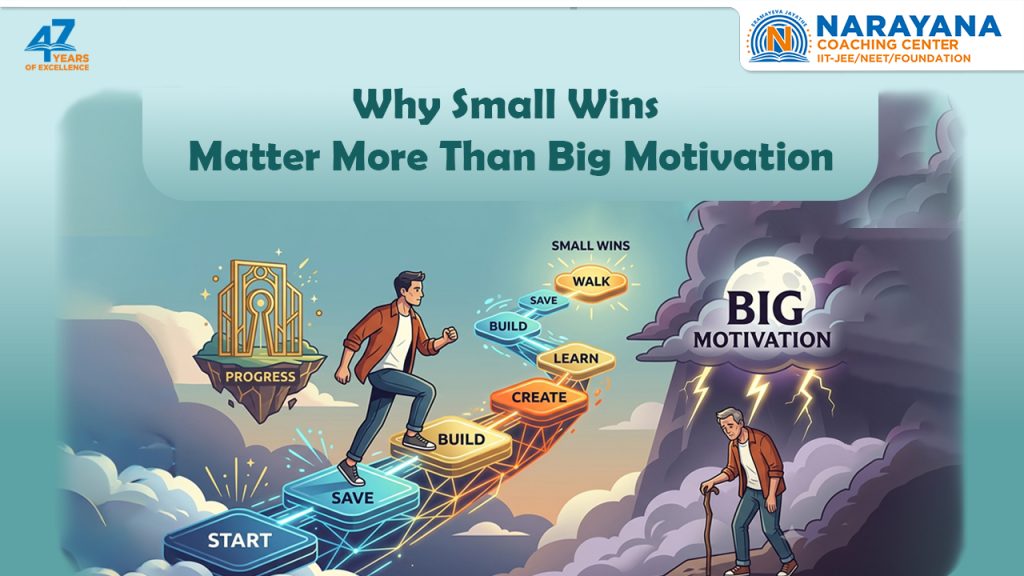
Preparing for JEE or NEET is often described as a journey that requires strong motivation. Students watch inspiring videos, create ambitious timetables, buy new study materials, and promise themselves that they will study ten or twelve hours every day.
For a few days, everything feels possible.
Then the excitement fades.
A difficult chapter appears, mock-test marks drop, pending portions increase, and the carefully planned routine begins to collapse. At this point, many students conclude that they have lost motivation.
But the real problem is not always a lack of motivation. It is depending too heavily on motivation in the first place.
Motivation is temporary. Small wins, however, create momentum. And during a long preparation journey like JEE or NEET, momentum is often more valuable than excitement.
Motivation Comes and Goes
Motivation is an emotion. Like every emotion, it changes depending on your mood, energy levels, surroundings, results, and confidence.
You may feel extremely motivated after watching a topper interview. But that feeling may disappear when you sit down to solve a difficult set of rotational motion questions or revise plant physiology after a tiring day.
This does not mean you are lazy or incapable. It simply means that motivation cannot be your only study strategy.
Serious preparation continues even on ordinary days—days when you do not feel energetic, confident, or inspired.
This is where small wins become powerful.
A small win is a simple, achievable action that moves you forward. It could be:
- Revising one formula sheet
- Solving ten quality questions
- Correcting mistakes from one mock test
- Completing one NCERT topic
- Studying without distraction for thirty minutes
- Improving accuracy in one chapter
These actions may appear minor, but they gradually strengthen your preparation.
Small Wins Make Starting Easier
One of the hardest parts of studying is starting.
When a student thinks, “I must complete the entire chapter today,” the task feels heavy. The brain immediately notices the effort involved and begins searching for an escape.
But when the goal is, “I will study this topic for twenty-five minutes,” starting feels much easier.
Once you begin, continuing becomes more likely.
For example, instead of planning to finish the entire chapter on electrostatics, decide to understand Coulomb’s law and solve five related problems. Instead of planning to revise all of organic chemistry, revise one reaction mechanism. Instead of deciding to complete the entire human physiology unit, revise one NCERT diagram and its explanation.
Small goals reduce resistance. They help you enter study mode without feeling overwhelmed.
Small Wins Build Confidence
JEE and NEET preparation can gradually damage confidence if students focus only on what is incomplete.
There is always another chapter to revise, another test to take, and another mistake to analyse. When attention remains fixed on the remaining syllabus, even hardworking students may feel that they are not doing enough.
Small wins provide visible evidence of progress.
Every completed task sends a message to your mind: “I can do what I planned.”
This matters because confidence is not built only through positive thinking. It is built through repeated proof.
When you complete a daily target, correct an old mistake, improve your test score, or finally understand a confusing concept, you create evidence that improvement is possible.
One small win may not transform your preparation. But hundreds of small wins can completely change how you see yourself.
Progress Creates Motivation
Many students believe they need motivation before taking action.
In reality, motivation often comes after action.
You may not feel like studying before you begin. But after solving a few questions correctly, your interest may increase. After completing a revision target, you may feel more confident. After understanding a difficult concept, you may naturally want to continue.
This creates a useful cycle:
Small action → visible progress → confidence → motivation → more action
Waiting to feel motivated can keep you inactive. Taking a manageable step can create the motivation you were waiting for.
Small Wins Improve Consistency
Competitive examinations are not cleared through one perfect day of study. They are cleared through repeated, focused effort over several months.
Studying twelve hours one day and doing nothing for the next two days is less useful than studying six focused hours consistently.
Small wins encourage consistency because they are realistic.
A student may not always be able to complete an entire chapter, but they can revise two pages of short notes. They may not be able to take a full mock test every day, but they can analyse ten incorrect questions. They may not feel prepared for a long study session, but they can begin with one focused block.
Consistency protects your preparation from mood swings. It keeps the connection with your subjects alive even on difficult days.
Small Wins Prevent the All-or-Nothing Trap
Many aspirants follow an all-or-nothing mindset.
If they cannot study for eight hours, they study for zero. If they miss the morning schedule, they waste the rest of the day. If they perform badly in one test, they assume the entire preparation is failing.
This mindset turns small setbacks into major losses.
A small-win approach teaches you to rescue the day.
Missed your morning session? Complete one strong revision block in the evening.
Scored poorly in a mock test? Identify three repeated mistakes and fix them.
Could not complete the planned chapter? Finish one important sub-topic and continue tomorrow.
A partially productive day is always better than a completely wasted day.
What Small Wins Can Look Like for JEE Students
For JEE aspirants, a small win may include:
- Solving five challenging mathematics problems with complete steps
- Revising key formulas from one physics chapter
- Practising one type of organic chemistry conversion
- Reducing calculation errors in a timed question set
- Reattempting previously incorrect questions without seeing the solution
The goal is not to chase a large number of questions blindly. A small number of well-analysed questions can improve concepts, speed, and accuracy.
What Small Wins Can Look Like for NEET Students
For NEET aspirants, a small win may include:
- Revising five NCERT pages actively
- Recalling one biology diagram without looking
- Solving thirty MCQs from one focused topic
- Reviewing incorrect assertion-reason questions
- Memorising one chemistry exception list
- Revising one physics formula group and applying it to questions
NEET preparation involves a large syllabus and high accuracy. Small revision cycles help prevent forgetting and make repeated recall easier.
Track Effort, Not Just Marks
Marks are important, but they do not improve every day.
You may study sincerely and still receive a disappointing mock-test score because improvement often appears after a delay.
That is why your daily tracker should include actions that you can control.
You can track:
- Focused study sessions completed
- Questions solved and reviewed
- Mistakes corrected
- Topics revised
- NCERT pages covered
- Distractions avoided
This does not mean ignoring test scores. It means judging your preparation through both results and process.
A student who is correcting mistakes consistently is moving forward, even if the score has not improved immediately.
Celebrate Without Becoming Complacent
Celebrating small wins does not mean becoming satisfied with minimum effort.
It means recognising progress so that you can continue.
After completing a difficult target, take a short break, tick it off your planner, talk to someone supportive, or simply acknowledge that you kept your promise.
The celebration should refresh you, not distract you.
Small wins are checkpoints, not the final destination.
Focus on the Next Step
JEE and NEET preparation can feel frightening when you think about the entire syllabus, competition, rank, college, and future at the same time.
You do not need to solve your entire journey today.
You only need to identify the next useful step.
The next twenty questions.
The next revision block.
The next mistake to correct.
The next chapter to strengthen.
Big motivation may help you begin, but small wins help you continue. And in competitive exam preparation, the student who continues steadily often goes further than the student who depends only on occasional bursts of inspiration.
Do not wait for the perfect mood.
Create one small win today—and let it become the beginning of your next productive streak.