
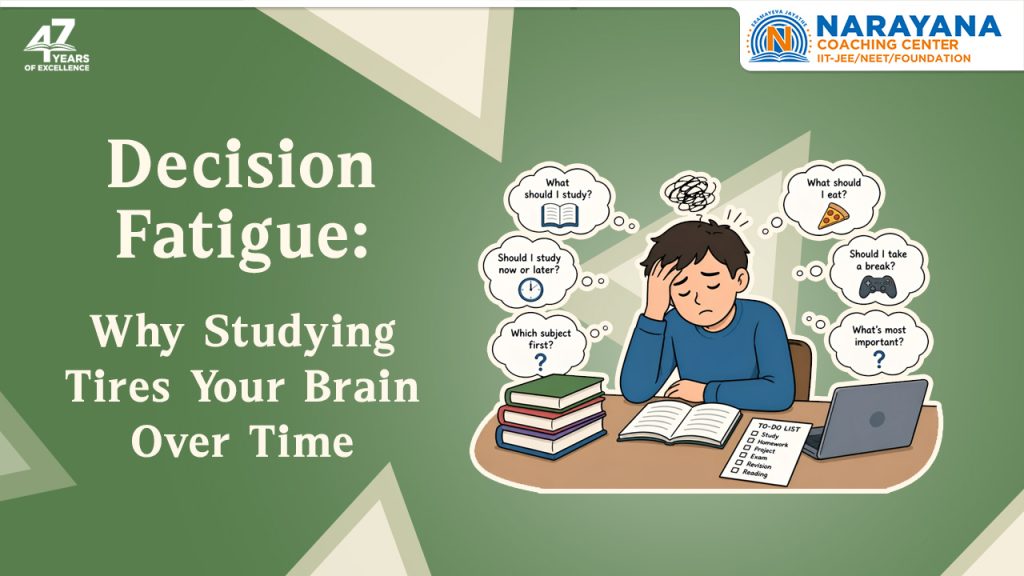
You sit at your desk with full intention to study. Books are open. Pens are ready. Your timetable is somewhere nearby. But instead of starting, your mind begins its usual debate.
Should I revise Physics first or solve Chemistry numericals?
Should I attempt a mock test or analyse yesterday’s mistakes?
Should I watch a lecture or read NCERT?
Should I study for one hour or two?
Should I take a break now or push myself?
By the time you finally decide what to do, you already feel tired.
This is not laziness. This is often decision fatigue.
For JEE and NEET aspirants, decision fatigue is one of the most unnoticed reasons behind poor productivity. You may have enough time, enough resources, and enough motivation, but if your brain is constantly forced to make small decisions, it slowly becomes mentally exhausted.
And once your brain is tired of deciding, it becomes tired of studying too.
What Is Decision Fatigue?
Decision fatigue means your brain’s ability to make good decisions reduces after making too many decisions.
Every day, your brain makes hundreds of choices. Some are simple, like what to eat or when to wake up. Others are more demanding, like which chapter to revise, which question to skip, or whether to change your test strategy.
For JEE and NEET students, these decisions are multiplied because exam preparation involves constant planning, comparison, correction, and self-monitoring.
You are not just studying. You are also deciding:
Which subject needs more attention?
Which teacher’s method should I follow?
Which book is better?
Which test series should I trust?
Which mistake is serious?
Which topic should I revise again?
Which backlog should I clear first?
Individually, these decisions may seem small. But together, they create a heavy mental load.
Why JEE and NEET Students Face Decision Fatigue
JEE and NEET preparation is not just academically difficult. It is mentally demanding because students are surrounded by options.
There are multiple books, online lectures, coaching notes, test series, revision sheets, previous year questions, short tricks, formula sheets, and strategy videos. Every resource looks useful. Every topper seems to suggest something different.
This creates a hidden pressure: the fear of choosing the wrong thing.
A JEE student may wonder, “Should I solve H.C. Verma again or move to previous year questions?”
A NEET student may think, “Should I revise NCERT Biology or practise Physics numericals?”
These are valid questions. But when such questions keep repeating throughout the day, they drain mental energy.
The problem becomes worse when students do not have a fixed system. Without a clear plan, every study session begins with fresh confusion. The brain has to spend energy deciding before it can spend energy learning.
How Decision Fatigue Affects Your Study Performance
Decision fatigue does not always feel like tiredness. Sometimes, it looks like procrastination. Sometimes, it looks like overthinking. Sometimes, it looks like suddenly scrolling through your phone even when you know you should be studying.
Here are some common signs.
You keep switching between subjects without completing anything.
You spend more time planning your study session than actually studying.
You open one chapter, feel unsure, close it, and open another.
You keep searching for the “best” strategy instead of following one.
You postpone difficult topics because choosing where to begin feels stressful.
You make careless mistakes in easy questions because your brain is already overloaded.
You feel mentally exhausted even before completing enough work.
This is why a student may sit for six hours but get only two hours of effective study done. The issue is not always lack of discipline. Sometimes, the brain has simply spent too much energy on unnecessary choices.
The Link Between Decision Fatigue and Willpower
Many students believe that toppers have extraordinary willpower. But in reality, successful students often depend less on willpower and more on systems.
Willpower is limited. If you use it repeatedly to force yourself to decide, resist distractions, choose tasks, and restart after every break, it gets weaker during the day.
This is why many students study well in the morning but struggle at night. By evening, the brain has already made several decisions. Even choosing one more chapter may feel heavy.
When decision fatigue sets in, the brain starts choosing easier options. It may prefer watching a lecture instead of solving questions. It may prefer highlighting notes instead of taking a mock test. It may prefer “planning tomorrow” instead of doing the difficult task today.
These choices feel productive, but they may not always move your preparation forward.
How to Reduce Decision Fatigue While Studying
The solution is not to make zero decisions. That is impossible. The solution is to reduce unnecessary decisions so your brain can focus on learning.
1. Decide Your Study Plan the Night Before
Do not begin your morning by asking, “What should I study today?”
Make this decision the previous night.
Write down the next day’s tasks clearly. For example:
Physics: 30 questions from Current Electricity
Chemistry: Revise Chemical Bonding notes
Biology: NCERT reading of Human Physiology, pages 1–12
Mock analysis: Review 15 wrong questions
This way, when you wake up, your brain does not need to negotiate. It only needs to begin.
2. Fix Subject Slots
Instead of deciding every day which subject to study first, create fixed slots.
For example:
Morning: Problem-solving subject
Afternoon: Theory-heavy subject
Evening: Revision and test analysis
A NEET student may keep Biology NCERT revision in the morning, Physics practice in the afternoon, and Chemistry in the evening. A JEE student may use mornings for Mathematics, afternoons for Physics, and evenings for Chemistry.
The exact order can vary. What matters is consistency.
When the slot is fixed, the decision disappears.
3. Limit Your Resources
Too many resources create too many decisions.
For each subject, decide your primary material. Your coaching notes, NCERT, previous year questions, and one main question bank are usually enough for focused preparation.
Do not keep switching because someone online recommended a new book or strategy. Every switch costs time and attention.
Depth is more important than variety. Repeating one good resource properly is better than touching five resources incompletely.
4. Create “Default Actions” for Low-Energy Moments
There will be times when you feel tired, confused, or unmotivated. Instead of asking, “What should I do now?” create default actions.
For example:
If I feel too tired for new concepts, I will revise formulae.
If I cannot solve hard questions, I will analyse previous mistakes.
If I feel distracted, I will do 20 minutes of NCERT reading.
If I feel anxious, I will attempt 10 familiar questions to restart momentum.
Default actions help you continue without wasting energy on decisions.
5. Use Checklists, Not Vague Goals
“Study Chemistry” is vague. It forces your brain to decide what exactly to do.
“Revise d-block reactions from NCERT and solve 25 PYQs” is clear.
Clear tasks reduce mental friction. They make starting easier and finishing measurable.
For JEE and NEET preparation, your checklist should include action words like revise, solve, analyse, memorise, test, correct, and repeat.
6. Protect Your Peak Brain Hours
Every student has certain hours when their mind is sharper. Use those hours for high-effort tasks like mock tests, numerical practice, organic mechanisms, or tough Mathematics problems.
Do not waste your best hours deciding, scrolling, arranging notes, or watching strategy videos.
Low-effort tasks can be done when your energy is lower. High-effort tasks deserve your freshest mind.
Decision Fatigue During Exams
Decision fatigue can also affect you inside the exam hall.
In JEE and NEET, you constantly decide which question to attempt, which one to skip, how much time to spend, and when to move on. If you have not practised this through mocks, the actual exam can feel mentally exhausting.
That is why mock tests are not only for checking knowledge. They are also for training your decision-making.
During mock analysis, observe:
Did I spend too long deciding on one question?
Did I change too many answers?
Did I skip easy questions because I panicked?
Did I attempt sections in the right order?
A strong exam strategy reduces decision fatigue during the final paper.
Conclusion
Your brain is not designed to make endless decisions all day and still perform at its best. If you want to study better, do not depend only on motivation. Build systems that reduce unnecessary choices.
Decide your plan before the day begins. Fix your study slots. Limit your resources. Use checklists. Create default actions. Practise exam decisions through mocks.
The less energy your brain spends on deciding, the more energy it can spend on understanding, remembering, and solving.
For JEE and NEET students, this can make a real difference.
Because sometimes, the problem is not that you are tired of studying.
Your brain is simply tired of deciding.