
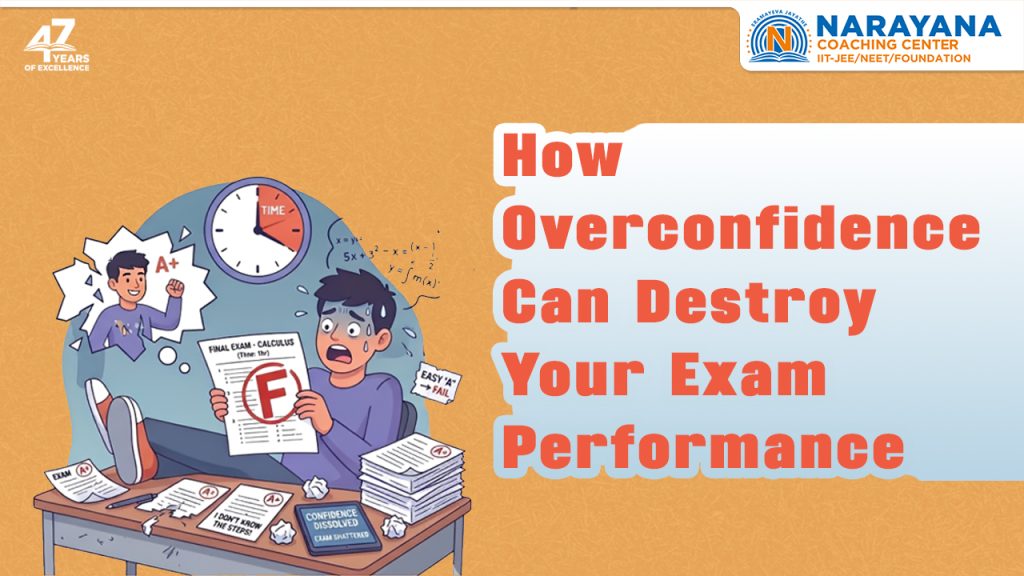
Confidence is important for every JEE and NEET aspirant. Without confidence, even well-prepared students may panic, doubt themselves, or underperform in the exam hall. But there is another side to confidence that students often ignore: overconfidence.
Overconfidence feels good in the beginning. It tells you, “I already know this chapter,” “This question is easy,” or “I don’t need to revise this again.” But slowly, it can become one of the biggest reasons behind silly mistakes, poor mock test scores, and disappointing exam performance.
For competitive exams like JEE and NEET, where lakhs of students compete and even a few marks can change your rank, overconfidence can be dangerous. It does not destroy performance in one dramatic moment. It does so quietly, through small habits that look harmless.
The Difference Between Confidence and Overconfidence
Confidence means you trust your preparation, but you are still alert. You know your strengths, but you also respect the difficulty of the exam.
Overconfidence means you assume you are safe without checking the reality. It makes you believe that because you understood something once, you will never forget it. It makes you feel that because you solved a type of question earlier, you can solve every question of that type correctly.
A confident student says, “I know this topic, but I will revise and practise it again.”
An overconfident student says, “I know this topic, so I can skip it.”
That small difference can decide your exam result.
1. Overconfidence Makes You Skip Revision
One of the most common mistakes overconfident students make is skipping revision of familiar chapters. In JEE, students may ignore topics like units and dimensions, basic algebra, vectors, or chemical bonding because they feel these are already “done.” In NEET, students may skip NCERT lines in Biology because they think they have read them many times.
But exams do not test whether you once understood a chapter. They test whether you can recall and apply it accurately under pressure.
A chapter that feels easy today can become confusing after two weeks if it is not revised. Formulae, exceptions, diagrams, reactions, and small conceptual details fade with time. Overconfidence hides this memory gap until a mock test exposes it.
The problem is that by then, the student may have already lost valuable preparation time.
2. It Increases Silly Mistakes
Many students lose marks not because they do not know the answer, but because they rush. Overconfidence often creates this rush.
When a question looks familiar, the mind immediately says, “I know this!” Then the student reads only half the question, skips important words, ignores units, or assumes what is being asked.
For example, a JEE student may solve for velocity when the question asks for acceleration. A NEET student may mark the correct statement when the question asks for the incorrect one. A Chemistry student may forget whether the question asks for major product, minor product, or order of reactivity.
These are not knowledge gaps. These are attention gaps.
Overconfidence reduces alertness. It makes easy questions dangerous because the student stops treating them with care.
3. It Makes Mock Test Analysis Weak
Mock tests are not just for checking scores. They are tools for diagnosis. They show where you are strong, where you are weak, and where you are careless.
But overconfident students often look only at the score. If the score is good, they feel satisfied. If the score is bad, they blame the paper, the environment, or “silly mistakes.”
The phrase “silly mistake” can become a trap. If you keep calling every error silly, you may never fix the pattern behind it.
Was the mistake due to poor reading?
Was it due to weak formula recall?
Was it due to speed pressure?
Was it due to confusion between two similar concepts?
Was it due to guessing without elimination?
A serious aspirant analyses mistakes. An overconfident aspirant explains them away.
In competitive exams, unanalysed mistakes repeat. And repeated mistakes become rank destroyers.
4. It Creates False Strengths
Sometimes, students believe they are strong in a subject because they enjoy it. A JEE aspirant who likes Mathematics may assume Maths will always save their score. A NEET aspirant who loves Biology may assume Biology is guaranteed.
But liking a subject is not the same as mastering it.
A student may enjoy solving Physics numericals but still struggle with multi-concept questions. Another may love Organic Chemistry but forget reaction conditions. A NEET student may be comfortable with Biology theory but miss assertion-reason questions or confusing NCERT-based options.
Overconfidence converts interest into illusion. It makes students believe that comfort equals accuracy.
The exam does not reward comfort. It rewards correct answers.
5. It Encourages Risky Guessing
JEE and NEET both require smart decision-making. You need to know when to attempt, when to skip, and when to return to a question later.
Overconfidence interferes with this judgment. It makes students think, “I am almost sure,” even when they are not. This leads to risky guesses, especially in questions with negative marking.
There is a big difference between an educated guess and an ego-based guess.
An educated guess is based on elimination, concept clues, and probability. An ego-based guess is based on the feeling that “I should know this.”
In competitive exams, emotions can be expensive. One wrong guess does not just reduce marks; it also affects confidence during the paper.
6. It Makes Students Ignore Basics
Advanced preparation is important, especially for JEE. But overconfident students often jump to difficult questions while ignoring fundamentals.
This is a major mistake.
Most difficult questions are built on simple concepts. If basics are weak, advanced problem-solving becomes unstable. In NEET, ignoring NCERT basics can be even more damaging because many questions are directly or indirectly based on textbook language.
Students sometimes chase tough questions to feel smart. But exam performance depends on balance. You need conceptual clarity, repeated practice, revision, accuracy, and time management.
A strong rank is not built only on solving difficult questions. It is built on not losing marks in questions you should have solved correctly.
7. It Affects Exam-Day Strategy
Overconfidence can be especially harmful on the actual exam day.
A student may start too fast because the first few questions look easy. Then, after making mistakes, panic begins. Another student may spend too much time on a difficult question because they believe they “must” be able to solve it. Some students ignore their planned subject order or time division because they feel unusually confident.
This is risky.
The exam hall is not the place to experiment with strategy. Your mock test strategy exists for a reason. Overconfidence makes students abandon discipline at the exact moment they need it most.
On exam day, calm confidence is useful. Emotional excitement is not.
How to Stay Confident Without Becoming Overconfident
The goal is not to become doubtful. The goal is to become realistic.
Start by tracking your mistakes honestly. After every mock test, classify errors into categories: conceptual error, calculation error, reading error, memory error, time-pressure error, and guessing error. This will show you your real preparation status.
Revise even your strong chapters. Strong chapters should not be ignored; they should be converted into guaranteed marks.
Read questions slowly, especially the ones that look easy. Underline or mentally note words like “incorrect,” “not,” “except,” “maximum,” “minimum,” and “closest.”
Respect NCERT, formula sheets, previous year questions, and mock test analysis. These are not basic tools; they are rank-building tools.
Most importantly, stay humble in preparation. Every chapter deserves attention. Every mock test deserves analysis. Every mistake deserves correction.
Conclusion
Overconfidence is dangerous because it feels like confidence. It makes you feel prepared while quietly weakening your discipline.
For JEE and NEET aspirants, the best mindset is simple: believe in your preparation, but verify it through practice, revision, and analysis.
Confidence says, “I can do this.”
Overconfidence says, “I don’t need to check.”
And in exams like JEE and NEET, the students who check, revise, analyse, and stay alert are the ones who protect their marks.
So, be confident. But stay careful. Your rank may depend on that balance.