
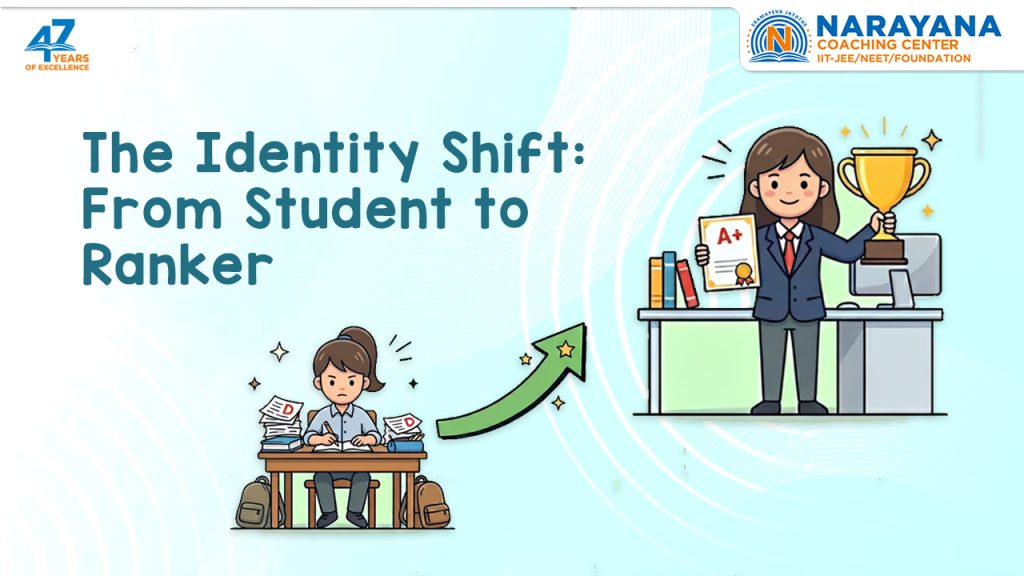
Every year, lakhs of students prepare for JEE.
Thousands study hard.
Many attend coaching classes, solve modules, and take mock tests.
But only a small percentage actually become rankers.
Why?
It is not always because they are the smartest.
It is not always because they study 16 hours a day.
And it is definitely not because they never feel tired or stressed.
The real difference often begins with something invisible:
Their identity.
At some point during preparation, successful aspirants stop seeing themselves as “students trying for JEE.”
They begin seeing themselves as future rankers.
That small mental shift changes everything.
Most Students Prepare “Casually”
A regular student often thinks like this:
- “I’ll study seriously from next month.”
- “Today was not productive… I’ll compensate tomorrow.”
- “I hope I get a good rank.”
- “Let me first complete the syllabus somehow.”
Notice the pattern?
There is uncertainty, hesitation, and inconsistency.
The preparation becomes emotional. Motivation changes every few days. Productivity depends on mood.
Now compare that with how a ranker thinks.
Rankers Operate Differently
A ranker does not wait to “feel motivated.”
A ranker thinks:
- “This chapter is weak. I need to fix it.”
- “My mock analysis is incomplete.”
- “I lost marks due to silly mistakes. That pattern must stop.”
- “This revision strategy is not efficient enough.”
The focus shifts from trying to improving.
That is the identity shift.
A ranker does not romanticise preparation.
A ranker treats preparation like responsibility.
Identity Controls Behaviour
This is the most important thing to understand.
Your actions usually follow your identity.
If you believe:
“I am just an average student.”
Then your mind unconsciously accepts:
- procrastination,
- inconsistency,
- excuses,
- random study habits.
But if you begin believing:
“I am becoming a serious JEE ranker.”
Your behaviour starts changing automatically.
Suddenly:
- skipping revision feels uncomfortable,
- wasting mock tests feels painful,
- Ignoring mistakes feels unacceptable.
Because your actions now conflict with your identity.
Stop Studying for Hours. Start Studying Like a Ranker.
Many students are obsessed with study hours.
“10 hours.”
“12 hours.”
“15-hour study routine.”
But rankers focus more on quality and intent.
A ranker studies with clarity.
Example:
A normal student solves 50 questions and feels satisfied.
A ranker asks:
- Why did I get Question 17 wrong?
- Was it a conceptual gap or calculation mistake?
- Did I panic under time pressure?
- Is this mistake repeating in other chapters too?
That reflection creates growth.
JEE is not won by blindly solving problems.
It is won by improving decision-making under pressure.
The Biggest Shift Happens After Mock Tests
This is where identity becomes visible.
What average students do after a bad mock:
- feel demotivated,
- compare themselves with others,
- avoid analysing the paper,
- say “paper was tough.”
What rankers do:
- analyse every error,
- classify mistakes,
- identify weak concepts,
- improve strategy for the next test.
To a ranker, a mock test is not a judgment.
It is data.
That mindset is powerful.
Rankers Respect Consistency More Than Motivation
Motivation is temporary.
Some days you will feel energetic.
Some days you will feel exhausted.
Some days Physics will feel impossible.
That is normal.
Rankers are not emotionally perfect people.
They simply continue working even on average days.
They understand something important:
Small consistent efforts create massive long-term results.
Two hours of focused revision daily for six months is far more powerful than random “motivation bursts.”
Your Environment Shapes Your Identity
If your entire routine looks casual, your preparation will also become casual.
Ask yourself:
- Is your study table organised?
- Do you revise regularly?
- Are your mock scores tracked properly?
- Do you maintain an error notebook?
- Do you protect your focus from distractions?
Rankers create systems.
They reduce dependence on mood and increase dependence on routine.
Even simple habits matter:
- fixed revision slots,
- proper sleep,
- planned mock analysis,
- limited social media,
- weekly target reviews.
These habits may look small individually. Together, they create a ranker mindset.
Stop Waiting to “Become” a Ranker
This is where many aspirants get stuck.
They think:
“Once I start scoring well, I’ll feel like a ranker.”
But the process actually works in reverse.
You must first start behaving like one.
Confidence is usually built through action, not before action.
The student who revises sincerely every day gains confidence.
The student who analyses mocks deeply gains confidence.
The student who improves mistakes consistently gains confidence.
Real confidence is earned through preparation quality.
A Ranker Is Not Someone Who Never Fails
This is another dangerous misconception.
Many toppers have:
- failed mock tests,
- struggled in certain subjects,
- faced burnout phases,
- scored badly at times.
But they did not attach their self-worth to one test.
Instead, they kept adapting.
That adaptability is what makes rankers dangerous competitors.
They recover quickly.
Build the Identity Through Small Daily Actions
You do not become a ranker overnight.
You become one through repeated behaviours.
Every time you:
- revise instead of postponing,
- analyse instead of complaining,
- focus instead of scrolling,
- improve instead of comparing,
you strengthen that identity.
The shift is gradual.
But once it happens, preparation changes completely.
You stop studying because parents told you to study.
You stop preparing just to “clear the exam.”
You begin operating with purpose.
Conclusion
JEE preparation is not only an academic journey.
It is also a psychological transformation.
At first, you may simply be a student attending classes and solving questions.
But eventually, the students who succeed make a mental transition.
They stop acting like passive learners.
They begin thinking, analysing, revising, and improving like rankers.
And that identity influences:
- discipline,
- consistency,
- focus,
- emotional stability,
- and ultimately, results.
So ask yourself honestly:
Are you still preparing like a student?
Or have you started preparing like a ranker?